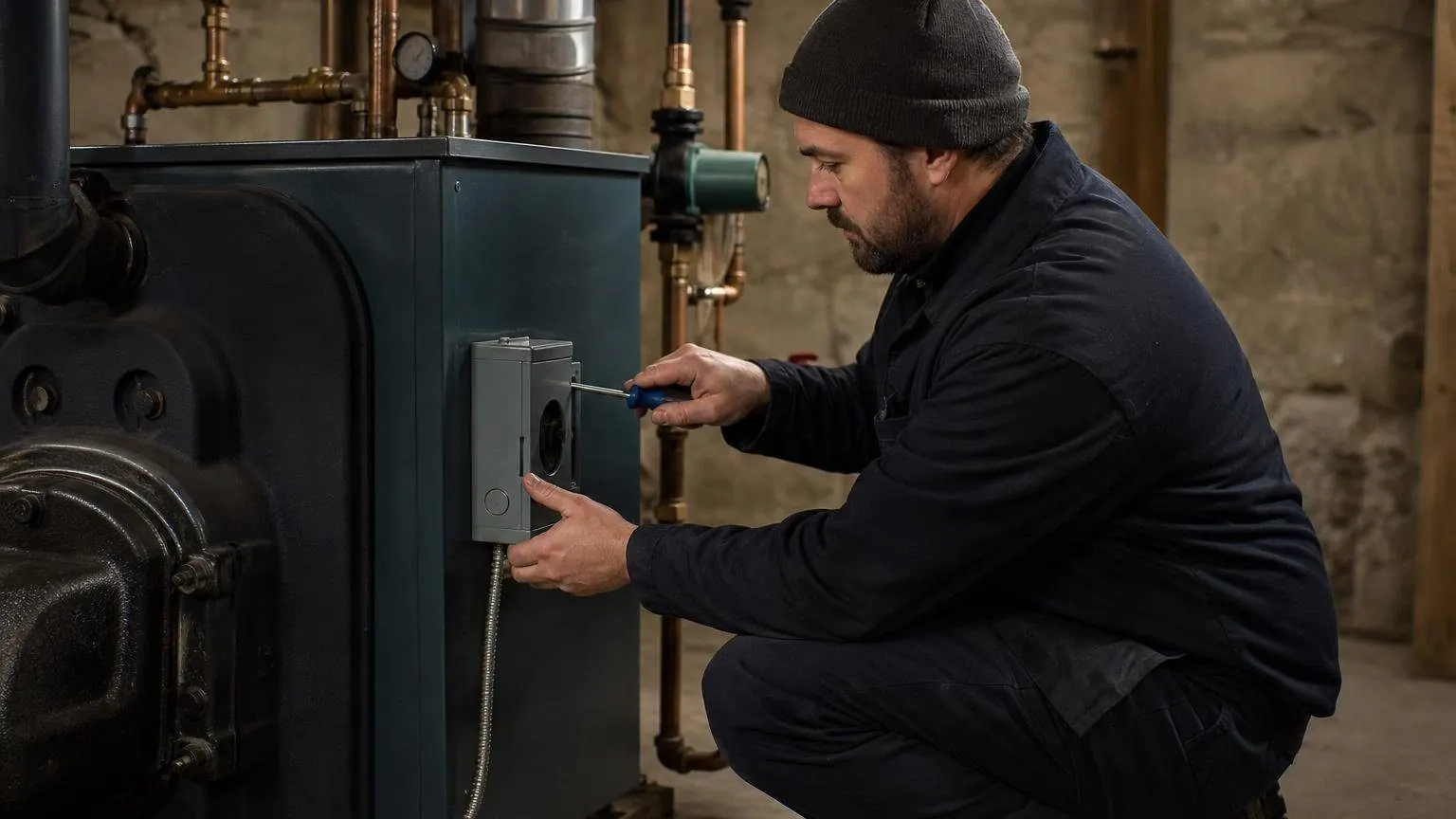
Typical boiler aquastat settings: high limit 180°F, low limit OFF unless the boiler heats domestic water with a tankless coil (then 150°F or higher and at least 10°F under the high limit), and a 10°F to 15°F differential. Those are the Burnham, Beckett, Hydrolevel and Resideo numbers; your boiler maker’s manual overrides them.
| Setting | Typical value | Where the number comes from |
|---|---|---|
| High limit | 180°F | Burnham V8H factory setting, adjustable 140°F to 240°F; Beckett’s AquaSmart example also uses 180°F |
| Low limit | OFF with no tankless coil; 150°F or higher with one, at least 10°F below the high limit | Hydrolevel 3200-Plus (OFF, 10° gap); Beckett AquaSmart (150°F floor on non-condensing boilers) |
| Differential | 10°F to 15°F as shipped; 20°F in Beckett’s example | Resideo L7224 (10°F) and L7248 (15°F) presets; Burnham V8H cold start (15°F) |
Compiled by The HVAC Brief from the Burnham V8H, Beckett AquaSmart, Hydrolevel 3200-Plus and Resideo 68-0281 manuals, read November 2026. The finder below adjusts these for your boiler, hot water and radiators.
An aquastat is a boiler’s water temperature control: it stops the burner at a high limit, can hold a low limit for a tankless coil, and switches the circulator. That low limit is what keeps a tankless coil boiler hot enough to heat tap water on demand, summer included. An indirect tank carries a second aquastat of its own, which calls the boiler like a zone thermostat; this guide covers both, with the setpoints and wiring rules from the boiler and tank makers’ manuals.
Key Takeaways
- The Honeywell/Resideo L8148 relay has a 180°F to 240°F standard high limit scale and a nonadjustable differential (Resideo 60-2278).
- Resideo’s electronic L7224 and L7248 replace the L8124A and L8148A; the cold start L7248 has a 15 °F high limit differential preset (form 68-0281).
- Hydrolevel says the low limit “should only be used for boilers with tankless coils” and ships it factory set to OFF (3200-Plus manual).
- Residential hot water boilers made on or after September 1, 2012 need automatic water temperature adjustment, except boilers with a tankless coil (10 CFR 430.32).
- Washington requires two high temperature limits on automatic hot water boilers, one manual reset above 400,000 Btu/hr (WAC 296-104-302).
What does an aquastat do on a boiler?
An aquastat senses boiler water temperature and switches the burner and circulator to keep it inside set limits. When the burner fires on a call but the pump stays still, a boiler circulator pump that is not working may simply not be getting line voltage from the aquastat or relay, which is the first branch to rule out. On a Resideo L8148, a 24 Vac thermostat call runs the burner and circulator, and the high limit shuts off only the burner when the water exceeds its setting (Resideo).
Aquastat is a registered Resideo mark, but the word covers any maker’s boiler water control, common on oil-fired boilers. In a hot water heating loop, it sets how hot the water gets.
Many units are “aquastat relays”: a high limit, switching relay and transformer in one box. Resideo says that transformer powers the low voltage control circuit, so a dead control can look like a dead thermostat. Burnham cast iron boilers with the IQ control take some guesswork out, flashing Err and StA readouts that the Burnham boiler error codes decode.
How do aquastat high limit, low limit and differential settings work?
The high limit stops the burner at a setpoint, the differential sets how far the water cools before it refires, and the low limit keeps the boiler warm between calls. In Beckett’s example, a 200°F high limit with a 20°F differential stops the burner at 200°F and restarts it at 180°F while the circulator keeps running (Beckett AquaSmart manual).
- High limit: an operating limit, not the final safety; the relief valve and, on larger boilers, a second manual reset limit sit above it.
- Differential: narrow means more burner starts; wide means longer, cooler swings.
- Low limit: fires with no thermostat call to keep water hot for a tankless coil.
- Circulator control: Beckett notes that turning the low limit off lets the thermostat run the circulator directly.
What do the L8148, L7248, AquaSmart and HydroStat manuals specify?
Ranges differ by model, so a replacement must match the old control’s function. Beckett’s cross-reference warns that limit and differential ranges on older controls “are not equivalent” (Beckett).
| Control (maker document) | Type | High limit range | Differential | Low limit |
|---|---|---|---|---|
| Resideo L8148A,E,J (60-2278) | Electromechanical relay | 180°F to 240°F (optional 140°F to 240°F) | Nonadjustable | None built in; terminals for a remote low limit |
| Resideo L4006A (60-2104) | High or low limit | 100°F to 240°F (or 40°F to 180°F) | 5°F to 30°F adjustable, or fixed | Can serve as one |
| Resideo L4006E (60-2104) | Manual reset high limit | 130°F to 290°F | Manual reset | None |
| Resideo L7248 (68-0281) | Electronic, cold start | 130 °F to 240 °F | 15 °F preset | None (external low limit on L7248L) |
| Resideo L7224 (68-0281) | Electronic, warm start | 130 °F to 240 °F | 10 °F preset | 110 °F to 220 °F |
| Beckett AquaSmart 7600 | Electronic, cold start capable | 100 to 220°F | 5 to 45°F | 100 to 205°F or OFF |
| Hydrolevel HydroStat 3200-Plus | Electronic, LWCO on Electro-Well | 100°-220°F | Automatic | Factory OFF; tankless coil only |
The L8148 has no low limit, so a tankless coil boiler needs an added control (Resideo’s diagrams show an L6006) or a different model. Resideo also states that a separate electromechanical high limit is not required with the L7224/L7248 to meet UL 726 for oil-fired boiler assemblies (Resideo 68-0281).
What should boiler aquastat settings be?
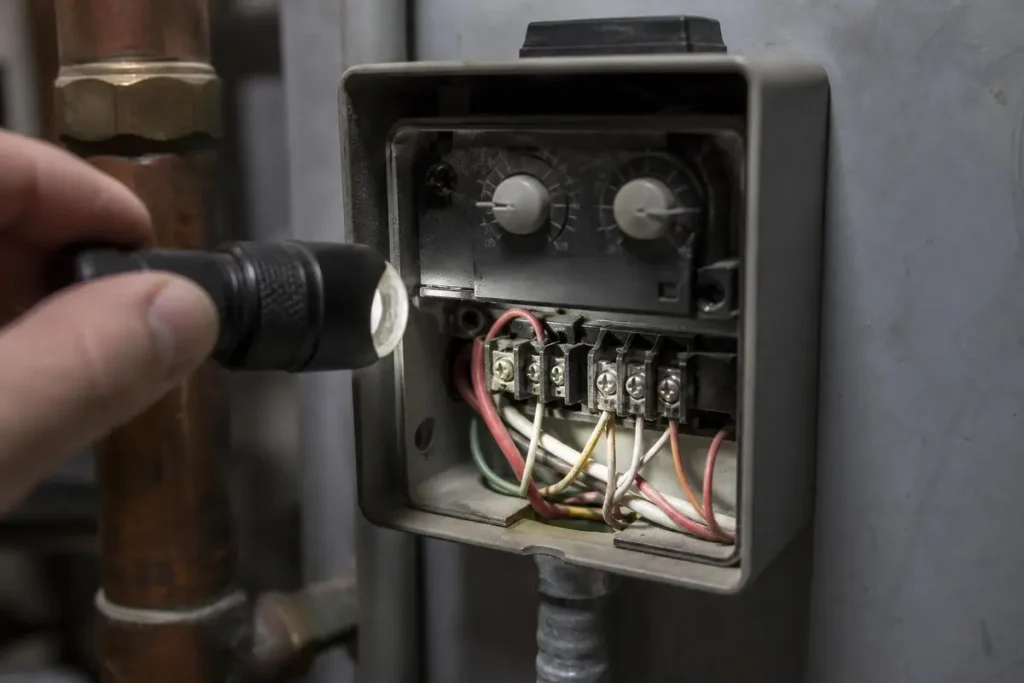
For a non-condensing oil or gas boiler, set the high limit at 180°F, leave the low limit OFF unless there is a tankless coil, and keep the factory differential. Narrowing that differential is a known cause of boiler short cycling, where the burner fires briefly, hits its limit and shuts off again within the same call for heat. Burnham ships its V8H oil boiler control at a 180°F high limit; the warm start version for tankless coil boilers adds a 110°F low limit with a 10°F low limit differential, and Burnham says these “may be varied to suit the installation requirements” (Burnham V8H manual).
No control maker publishes a universal number. Resideo’s L8148 instructions say: “Follow the boiler manufacturer recommendations for proper setting” (Resideo).
The manuals do set guardrails. Beckett says a low limit on a non-condensing boiler, if used, should be 150° F or above to limit flue gas condensation, unless the boiler maker says otherwise. Hydrolevel wants it at least 10° below the high limit. Beckett’s control enforces a gap of the larger differential plus 5°F: a 180°F high limit with a 20°F differential allows no low limit above 155°F.
Do not raise the high limit to cure weak heat without the boiler manual. Resideo says its aquastats are intended only for systems with a pressure relief valve (Resideo 60-2104).
Two manuals, two low limits
Beckett’s 150°F floor is a control maker’s general rule for non-condensing boilers, and its manual adds that the appliance maker’s temperature requirements supersede it. Burnham, the appliance maker, ships its V8H warm start control at 110°F. On a Burnham V8H, Burnham’s number is the one that applies; on a boiler whose manual gives no low limit, Beckett’s 150°F is the documented floor.
What aquastat settings fit your boiler, hot water and radiators?
The three choices that change the answer are a tankless coil (it decides whether a low limit is on at all), the boiler type (a condensing boiler has no separate aquastat) and the emitters (radiant floors need far cooler water than baseboard). The finder applies the maker rules for each combination.
Aquastat setting finder
Pick your boiler, how it makes hot water and what heats the rooms. Every number below is quoted from a maker manual named in the result.
Sources: Burnham V8H manual 110218-06; Beckett AquaSmart Form 61738; Hydrolevel 3200-Plus manual; Resideo 60-2278 and 68-0281; Weil-McLain ECO Tec series 2 Advanced Manual 550-100-272 (Figure 25 presets); Weil-McLain Gold CGa boiler manual (130°F return). These are maker specifications, not our tests. The boiler maker’s manual overrides any number here.
The same rules as a table, for checking a setting without the finder:
| Setup | High limit | Low limit | Differential | Rule source |
|---|---|---|---|---|
| Non-condensing oil or gas, tankless coil, baseboard or radiators | 180°F start (Burnham factory) | ON: 150°F to 170°F with a 180°F high limit | 10°F to 15°F (factory presets) | Burnham V8H; Beckett 150°F floor; Hydrolevel 10° gap |
| Same, on a Beckett AquaSmart | 180°F | No higher than 155°F with a 20°F differential, 165°F with 10°F | 5°F to 45°F adjustable | Beckett: high limit minus larger differential minus 5°F |
| Non-condensing, indirect tank or separate water heater | 180°F start | OFF (cold start) | 10°F to 15°F | Hydrolevel, Burnham, Beckett cross reference |
| Non-condensing, fan coil or hydro-air | 180°F or more | OFF unless tankless coil | 10°F to 15°F | Burnham: fan coils may need 180°F or 160°F |
| Non-condensing, radiant floor | Boiler at its own limit (180°F start) | OFF unless tankless coil | 10°F to 15°F | Mixing device holds radiant supply at the emitter maximum; boiler return at least 130°F (Weil-McLain Gold CGa) |
| Condensing boiler, any emitter | No aquastat: maximum supply by emitter (next table) | Not used | Boiler control | Weil-McLain ECO Tec presets |
Compiled by The HVAC Brief from the Burnham V8H, Beckett AquaSmart, Hydrolevel 3200-Plus, Resideo 68-0281, Weil-McLain ECO Tec and Weil-McLain Gold CGa manuals. The 170°F and 165°F ceilings are our arithmetic from each maker’s rule with a 180°F high limit.
What water temperature do baseboard, radiators and radiant floors need?
About 180°F for baseboard, cast iron radiators and fan coils, and 120°F to 160°F for radiant floors, depending on how the tubing is installed. Those are the maximum targets in the system type presets of Weil-McLain’s ECO Tec condensing boiler, where the maximum is the supply temperature “at design maximum heat loss” and the minimum is how low the water may go in mild weather (Weil-McLain ECO Tec Advanced Manual, Figure 25).
| Emitter (Weil-McLain system type) | Maximum target | Minimum target |
|---|---|---|
| Fan coil | 180°F | 140°F |
| Finned tube baseboard | 180°F | 130°F |
| Cast iron baseboard | 180°F | 120°F |
| Cast iron radiators | 180°F | 120°F |
| Radiant, slab on grade | 120°F | 80°F |
| Radiant, thin slab | 140°F | 80°F |
| Radiant, below floor (staple up) | 160°F | 90°F |
| Radiant, above floor (sleeper system) | 140°F | 90°F |
Source: Weil-McLain, ECO Tec series 2 Advanced Manual, part 550-100-272/1023, Figure 25, factory settings for each system type.
A non-condensing cast iron boiler cannot simply run at radiant temperatures. Weil-McLain’s Gold CGa manual has bypass valves “set to assure a minimum return water temperature (at least 130°F) to the boiler”, requires a gauge showing the water supplied to the radiant tubing, and warns that cold return water “could cause corrosion damage to the sections or burners” (Weil-McLain Gold CGa manual, mirror copy). The aquastat keeps the boiler hot; a mixing device, sized by the installer, sets the floor temperature. Our radiant floor heating guide covers the floor side.
Does a boiler without a tankless coil need a low limit?
Usually not. If hot water comes from an indirect tank on its own zone or a separate heater, Hydrolevel says the low limit “should be turned to OFF (fully counterclockwise) when the boiler does not have a tankless coil” (Hydrolevel).
Correction: “every boiler needs a low limit”
A widely read settings guide says to set the low limit 20°F under the high limit, without asking whether the boiler has a tankless coil. Maker manuals disagree: Beckett’s cross-reference repeats “Set low limit on 7600 to OFF” for many replacements.
Federal rules require automatic water temperature adjustment on all but tankless coil boilers. Under 10 CFR 430.32(e)(2), a single input boiler complies by firing only when residual heat cannot meet the load. The L7248’s thermal purge “may delay the burner operation while the residual heat is circulated out of the boiler,” per Resideo. Circulating after a call is often deliberate, and a boiler pump running constantly separates a set overrun from a thermostat still calling, a shorted wire, a zone valve lever left open or a stuck relay.
How do you set and wire the aquastat on an indirect water heater or tankless coil?
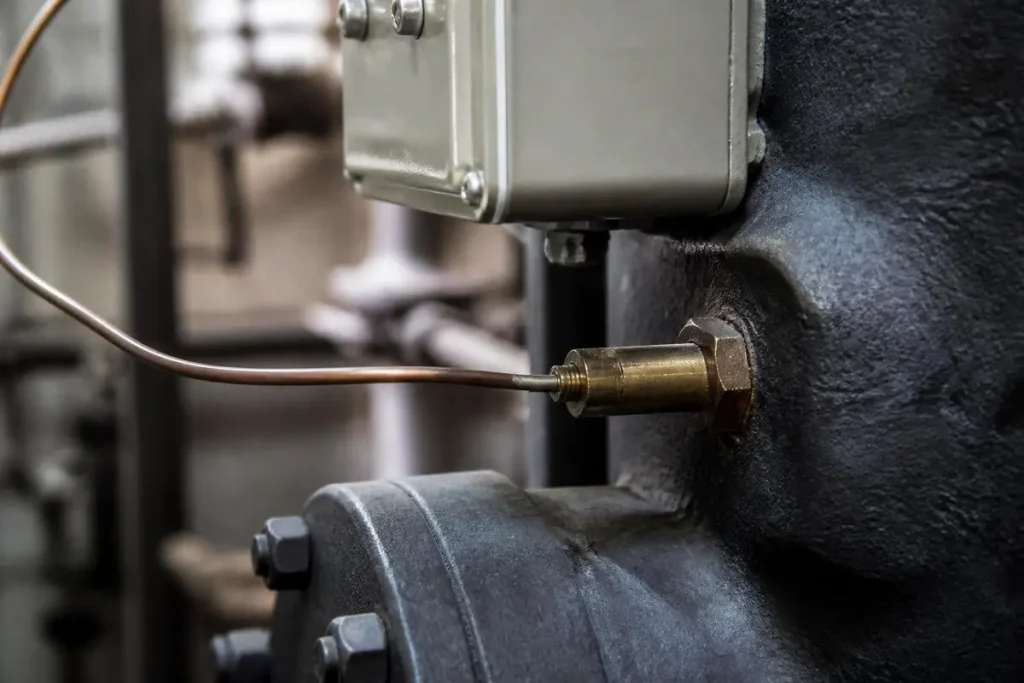
An indirect tank has its own aquastat, and it does not fire the burner. It is a low voltage switch in a dry well that closes on a call for hot water, like a zone thermostat. The boiler aquastat still sets how hot the boiler water gets. Weil-McLain’s Aqua Plus takes 24 VAC field wiring only, at a two-pole terminal block (Weil-McLain GL-E223-ADOC). On a Burnham V8H, the tank aquastat lands on the ZR terminal and the hot water circulator on ZC (Burnham V8H manual). Amtrol’s BoilerMate diagrams route it through a Honeywell R4222D relay, a zone valve end switch or the DHW zone of a zone controller.
| Tank (maker document) | Tank aquastat as shipped | Boiler limit rule |
|---|---|---|
| Amtrol BoilerMate CH (9040-586-04/21) | 120°F; digital control 90°F to 150°F, 10°F default differential | Priority off by default (setting “n”) |
| Weil-McLain Aqua Plus (GL-E223-ADOC) | Lowest setting | At least 20°F above the tank; never above 200°F |
| Triangle Tube SMART (Phase III guide) | Lowest setting | At least 20°F above the tank; never above 210°F |
Compiled by The HVAC Brief from the Amtrol, Weil-McLain and Triangle Tube installation manuals, read November 2026.
Priority decides what happens when the tank and the house call together. Burnham says to use priority zoning with an indirect tank, but not on hydro-air systems, and ships the V8H with Priority Time on, which forces the system circulator off during a hot water call. Amtrol warns that priority postpones space heating until the tank is satisfied; a failed circulator or tank thermostat can delay heat “indefinitely” and freeze pipes (Amtrol BoilerMate manual). Our indirect water heater guide covers priority zones and tank sizing in full.
Tank temperature is a trade between scald and Legionella. Amtrol cites the Consumer Product Safety Commission’s 120°F starting point. OSHA’s Legionella guidance calls for storing hot water at 140°F or more and delivering at least 122°F to outlets (OSHA). A 140°F tank needs a tempering valve: Triangle Tube specifies one that complies with ASSE 1017 (Triangle Tube guide).
A tankless coil has no tank aquastat; the boiler’s low limit is its thermostat. Burnham requires an automatic mixing valve at the coil outlet (“DO NOT operate tankless heater without mixing valve”) and a flow regulator in the cold line, at least 3 ft from the inlet, matched to the coil rating: 3.00 GPM on a V8H3 up to 4.25 GPM on a V8H7. When an indirect tank replaces the coil, Weil-McLain and Triangle Tube both say to disconnect and drain the coil and never plug it.
Immersion well or strap-on: where does the sensor go?
Immersion models read water through a well, a closed sleeve threaded into a boiler tapping that holds the sensing bulb. Strap-on models such as the L6006C clamp to a pipe, with a 65°F to 200°F range. Resideo warns: “Do not replace immersion-type Aquastat Controller with strap-on Aquastat Controller” (Resideo 60-2104).
Resideo says the bulb must bottom in the well, with heat-conductive compound if loose, and never sit close to a hot or cold water inlet or a steam coil. The L8148 well is rated to 255 psi.
How do you adjust an aquastat?
Open the control, change the high limit first, then the low limit and differential, and watch one full burner cycle. On an oil boiler, a burner that starts and then stops with a red light on its primary control has locked out rather than reached its limit, and the oil burner reset button sorts that lockout into fuel, ignition or cad cell causes. Delayed ignition and soot often start at the burner nozzle, which is why oil burner nozzle replacement belongs to every annual service and is followed by a combustion test rather than a guess at the air setting. The cover of an L8148 hides 120 volt terminals, so switch the boiler off at its service switch before removing it. The method differs by control:
- Resideo / Honeywell L8148 (dial): “With cover off, turn the dial until the desired setting is directly below the indicator.” Models with a dial stop are set with a small screwdriver (Resideo 60-2278, Fig. 15). The differential cannot be changed.
- Resideo L7224 and L7248 (digital): press UP, DOWN and I together for three seconds to enter adjustment mode, press I until HL, Hdf, LL or Ldf shows, then use UP or DOWN. The control returns to run mode after 60 seconds without a key press (Resideo 68-0281).
- Burnham V8H boiler control: the same three key press for three seconds. The cold start version lists HL_ and HdF; the warm start version lists HL_, LL_ and Ldf. It returns to operating mode after five minutes idle.
- Beckett AquaSmart 7600: press the HIGH LIMIT, LOW LIMIT, HIGH DIFF or LOW DIFF key, tap the arrows (1° per tap, 5° when held) and press ENTER (RESET) to confirm. Beckett warns that live line voltage is exposed while programming, so touch only the keypad (Beckett Form 61738).
- Hydrolevel HydroStat 3200-Plus: turn the HI TEMP dial; for a tankless coil, turn the LO TEMP dial clockwise. If the low limit will not go above 140°F, Hydrolevel says to remove the jumper.
Then let the system run. Resideo’s checkout step is to “observe at least one complete cycle” to confirm the control operates properly.
How do you know if an aquastat is bad?
Bad aquastat symptoms are no heat with the thermostat calling, overheating or relief valve discharge, short cycling, and lukewarm tankless hot water. Other parts cause these too, so work in order; leave anything past the owner checks for a boiler that won’t run to a licensed technician.
- Read the display. On an L7224 or L7248, Err1 is a sensor fault, Err4 a burner output (B1) fault and Err5 low line voltage, per Resideo’s code table.
- Allow for thermal purge. A cold start control may run the pump with the burner held off while it uses stored heat. That is normal.
- Check control power. The relay’s transformer feeds the thermostat circuit; a failed 24V transformer kills every heat call it powers.
- Check the pump side. If the burner fires but rooms stay cold, check the circulator and any zone valve first.
- Treat overheating as urgent. Water past the high limit or a discharging relief valve means shut down and call for service; see normal boiler pressure for gauge readings.
- Respect a manual reset trip. An L4006E locks out at setpoint and resets only after the water drops 20°F below it. Repeat trips mean a fault upstream.
- Check the sensor seat. A bulb that does not bottom in its well, or a well near an inlet, misreads water temperature.
What does code require for a boiler high limit control?
In many jurisdictions, an automatically fired hot water boiler needs an operating control plus a separate high temperature limit, manual reset on larger boilers. Details come from ASME CSD-1 as adopted or state boiler rules, and home boiler coverage varies by state. On a Weil McLain boiler the fault display and the reset location differ by line, from flashing lights to worded screens, as the Weil McLain boiler error codes show.
| Jurisdiction (rule) | What it requires |
|---|---|
| California (2025 CMC 1003.2.1) | Controls per ASME CSD-1 or Table 1003.2.1; two high temperature limit controls, manual reset not required on an approved package boiler up to 400,000 Btu/h |
| Washington (WAC 296-104-302) | Two high temperature limit controls, the highest with manual reset above 400,000 Btu/hr, plus a manual reset low water fuel cutoff |
| North Carolina (13 NCAC 13 .0406) | An operating control and a high temperature limit, each with its own sensing element; automatic or remote electronic resets prohibited |
Sources: California Mechanical Code text, WAC 296-104-302 and 13 NCAC 13 .0406. Washington also requires a manual reset low water cutoff against dry firing; the HydroStat gives that protection only on an Electro-Well.
How we researched this
Research dates: October 15 to 18, 2026, updated November 11, 2026. We cite 12 sources: eight maker documents, the eCFR text of 10 CFR 430.32 and three state code texts. In November we re-read the Resideo, Beckett and Hydrolevel manuals and the eCFR text, and added the Burnham V8H manual (factory settings), the Weil-McLain ECO Tec Advanced Manual (emitter presets) and the Weil-McLain Gold CGa manual (130°F return). Every range is a maker specification, not a tested result.
Excluded: setting numbers from top-ranking explainers (none cite a manual), Beckett’s “up to 20%” HeatManager savings claim (marketing), HydroStat factory and low limit figures (its manual conflicts with itself), and prices (no federal series). Reddit was skipped because boiler limits are a safety topic.
Frequently asked questions
What temperature should an aquastat be set at?
Start at a 180°F high limit, which is Burnham’s factory setting on its V8H oil boiler control. Leave the low limit OFF unless the boiler has a tankless coil; with one, Beckett says 150°F or above on a non-condensing boiler. Resideo’s L8148 instructions add that the boiler maker’s recommendation governs.
What should the high and low settings be on an oil burner aquastat?
With a tankless coil, a 180°F high limit and a low limit between 150°F and 170°F meets Beckett’s 150°F floor and Hydrolevel’s rule that the low limit sit at least 10° below the high limit. Burnham’s warm start control ships at 180°F and 110°F instead, and on that boiler Burnham’s figures apply.
What should the aquastat be set at for domestic hot water?
For a tankless coil, the low limit holds the boiler hot for showers: 150°F or more per Beckett, at least 10° under the high limit per Hydrolevel. For an indirect tank, keep the low limit OFF and let the tank’s own call fire the boiler; Weil-McLain’s ECO Tec preset for domestic hot water is a 180°F maximum.
What happens when an aquastat goes bad?
Typical results are no heat, a burner that will not stop at the high limit, or short cycling. Electronic Resideo models show faults on the display, such as Err1 for a sensor fault. Overheating with relief valve discharge means shut the boiler down and call for service.
How much does an aquastat cost?
We do not publish a price because no federal or national lab source tracks aquastat or installation costs. Matching function matters more: Beckett warns that limit and differential ranges on some older controls are not equivalent to its AquaSmart, so the right replacement may not be the cheapest.
Can I replace an immersion aquastat with a strap-on one?
Resideo says no: “Do not replace immersion-type Aquastat Controller with strap-on Aquastat Controller.” Strap-on models such as the L6006C sense pipe surface temperature and have a 65°F to 200°F range, so they do not read boiler water the way a sensor in an immersion well does.
Why does my boiler run the pump before the burner fires?
That is likely thermal purge on a cold start control. Resideo’s L7248 holds the burner off while the circulator uses residual heat, matching the federal rule for single input boilers. Its frost protection still forces the burner on at a fixed 40 °F.
Is an aquastat high limit a safety control?
It is an operating limit that also caps temperature, but codes often want more. North Carolina requires a separate high temperature limit with its own sensing element. California requires two high temperature limit controls on automatic hot water boilers, waiving manual reset only on approved package boilers up to 400,000 Btu/h.
What temperature should an indirect water heater aquastat be set at?
Start low and raise it only as needed. Amtrol ships the BoilerMate at 120°F, the starting point the Consumer Product Safety Commission recommends. Weil-McLain and Triangle Tube ship their tanks at the lowest setting and want the boiler limit at least 20°F above the tank setting. OSHA's Legionella guidance stores hot water at 140°F or more, which calls for a mixing valve at the tank outlet.
Does a tankless coil need a mixing valve?
Yes. Burnham's V8H manual says "DO NOT operate tankless heater without mixing valve" and also requires a flow regulator in the cold line matched to the coil rating, 3.00 to 4.25 GPM depending on boiler size. The boiler's low limit holds the coil hot enough to make hot water, so the water leaving the coil can be far above a safe tap temperature.
Sources
- Resideo. “L8148A,E,J Aquastat Relays, Product Data, 60-2278-10.” https://res.cloudinary.com/dzhpkjoqj/Resideo/60-2278.pdf. Accessed November 2026.
- Resideo. “L4006,7,8; L6006,7,8 Aquastat Controllers, Product Data, 60-2104-11.” https://res.cloudinary.com/dzhpkjoqj/Resideo/60-2104.pdf. Accessed November 2026.
- Resideo. “L7224A,C; L7248A,C,L Oil and Electric Boiler Electronic Aquastat Controllers, 68-0281-24.” https://res.cloudinary.com/dzhpkjoqj/Resideo/68-0281.pdf. Accessed November 2026.
- Beckett. “AquaSmart Boiler Control Manual, Form 61738.” https://www.beckettcorp.com/wp-content/uploads/2022/05/AquaSmart-7600-Burner-Control-Manual.pdf. Accessed November 2026.
- Hydrolevel. “Model 3200-Plus Installation Instructions and Operating Manual.” https://pexuniverse.com/uploads/literature/hl-hs-3200-plus-ins.pdf. Accessed November 2026.
- eCFR. “10 CFR 430.32, Energy and water conservation standards.” https://www.ecfr.gov/current/title-10/chapter-II/subchapter-D/part-430/subpart-C/section-430.32. Accessed November 2026.
- Washington State. “WAC 296-104-302, control and limit devices.” https://www.law.cornell.edu/regulations/washington/WAC-296-104-302. Accessed October 2026.
- North Carolina. “13 NCAC 13 .0406, High pressure or temperature limit control.” https://www.law.cornell.edu/regulations/north-carolina/13-N-C-Admin-Code-13-0406. Accessed October 2026.
- Burnham. “V8H Series Installation, Operating and Service Instructions, 110218-06 (2/24).” https://s3.amazonaws.com/s3.supplyhouse.com/product_files/Burnham-V8HSeries-Installation.pdf. Accessed November 2026.
- Weil-McLain. “ECO Tec series 2 Advanced Manual, part number 550-100-272/1023.” https://www.weil-mclain.com/wp-content/uploads/ECO-Tec-Series-2-Advanced-Manual-1023.pdf. Accessed November 2026.
- Weil-McLain. “GOLD CGa Gas-Fired Water Boiler, Boiler Manual” (mirror copy, page 20). https://www.manualsdir.com/manuals/223933/weil-mclain-gold-cga.html?page=20. Accessed November 2026.
- California Building Standards Commission. “2025 California Mechanical Code, Section 1003.2.1 and Table 1003.2.1” (code text as hosted by GoCodebook). https://gocodebook.com/us/california/california-mechanical-code/boilers-and-pressure-vessels/safety-controls-gauges-and-expansion/controls-and-limit-devices-for-automatic-boilers. Accessed October 2026.
- Weil-McLain. “Aqua Plus Indirect-Fired Water Heaters, Product Manual, GL-E223-ADOC 0615.” https://www.weil-mclain.com/wp-content/uploads/aquaplus-manual_1.pdf. Accessed November 2026.
- Amtrol. “BoilerMate Indirect-Fired Water Heaters, Installation & Operation Instructions, 9040-586-04/21.” https://res.cloudinary.com/dzhpkjoqj/Amtrol/9040-586-04_21-BOILERMATE-IO_pcrnb6.pdf. Accessed November 2026.
- Triangle Tube. “Phase III TR Series and SMART Series Indirect Fired Water Heaters, Installation and Maintenance Guide” (retailer-hosted copy). https://cdn.shopify.com/s/files/1/2380/1317/files/Smart_Install_Manual.pdf. Accessed November 2026.
- Occupational Safety and Health Administration. “Legionnaires’ Disease: Control and Prevention.” https://www.osha.gov/legionnaires-disease/control-prevention. Accessed November 2026.
Leave a Reply