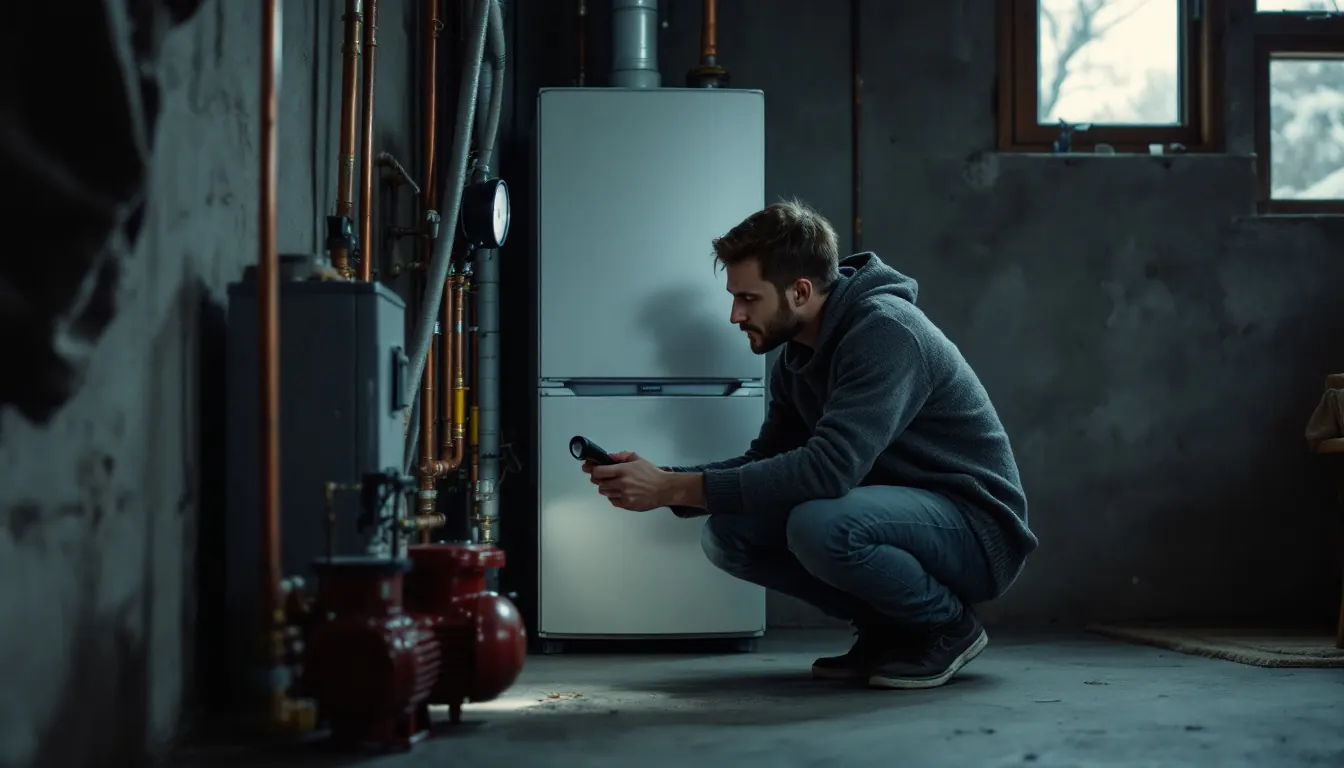
Boiler not working? Match the symptom first. A dead unit is power, the thermostat or gas supply; a LOCKOUT screen allows one reset; a burner that fires while rooms stay cold is pressure, the pump or air; a condensing boiler that quits in a freeze often has a frozen condensate line.
Which boiler is it, and what exactly is it doing?
The kind of boiler and what it does on a heat call settle most of the diagnosis. A cast iron gas boiler with a draft hood, such as Weil-McLain’s CGa or EG, has a spill switch and a rollout fuse that shut the gas off and must not be reset by an owner. A wall-hung condensing boiler, such as Weil-McLain’s ECO Tec, runs a fan, drains acidic condensate and shows a named fault on a screen. A steam boiler has a gauge glass and a low water cutoff that stops the burner when the water drops.
Steam or hot water heat ran in 9.29 million US homes in 2020 (EIA RECS Table HC6.1). Find your row below, then read only the section it points to.
| What you see | Cast iron gas, draft hood | Condensing, wall hung | Steam | Owner stops at |
|---|---|---|---|---|
| Nothing at all: no display, no hum | Service switch, breaker, thermostat | Same, plus a blank screen | Same | A breaker that trips twice |
| Locked out, reset light or LOCKOUT screen | Spill switch or rollout fuse: no restart | Named fault; IGNITION 1 FAULT clears itself after 1 hour | Low water cutoff or pressure control | Second lockout |
| Burner fires, rooms cold | Gauge, circulator, zone valves, air | Same | Air vents, pressuretrol, piping | Pressure above 24 psig (hot water) |
| Turns on and off every few minutes | Limit setting, low flow, thermostat location | Same | Pressuretrol setting | Any adjustment inside the jacket |
| Quit in a hard freeze | Frozen piping after a power loss | Frozen or blocked condensate line, dry trap | Frozen piping after a power loss | Dry condensate trap |
| Gauge glass empty | Not applicable | Not applicable | Low water cutoff tripped, usually a leak | Never add cold water to a hot boiler |
Compiled by The HVAC Brief from Weil-McLain 550-142-301, Weil-McLain 550-100-270 (ECO Tec series 2) and the DOE Building America steam measure guideline. Your own manual governs.
Boiler completely dead with no display: what can you check without tools?
Check four inputs in this order: the service switch (often at the top of the basement stairs or on the boiler), the breaker, a thermostat set to HEAT and above room temperature, and the manual gas valve handle, which should sit in line with the pipe. Reset a tripped breaker once; if it trips again, leave it off, because a shorted pump, igniter or control is now the likely cause.
On a gas boiler built since January 15, 2021 there is no standing pilot to relight: 10 CFR 430.32(e)(2)(iii)(A) sets 84 percent AFUE for gas hot water boilers and 82 percent for gas steam boilers, with a constant-burning pilot not permitted in either class. An older cast iron boiler with a pilot that will not stay lit is a thermocouple or pilot assembly job for a technician. On an oil boiler, the button on the burner’s primary control is a lockout reset, and the guide to the oil burner reset button covers when pressing it is safe.
LOCKOUT on the screen or the reset light on: how many resets are safe?
One. A lockout means a safety check failed, and Weil-McLain’s user manual for its CGa, CGi, EG, PEG and LGB boilers says to reset after resolving the fault and, if the fault recurs, to contact a service technician.
Two devices are never owner resets. On the CGa, EG and PEG, the spill switch cuts off gas flow should the vent system become blocked, and the rollout thermal fuse element cuts off gas should flame roll out of the burner area. For both, the manual says: “Do not attempt to place boiler in operation” and to call a service technician immediately.
Condensing boilers count their own tries before they lock. On the Weil-McLain ECO Tec series 2, IGNITION 1 FAULT means the boiler went through 5 ignition attempts and never detected flame; it resets automatically after 1 hour, and the first corrective action the boiler manual lists is to check the condensate trap for a blockage that lets condensate collect in the heat exchanger. A LOW WTR CUTOFF OPEN fault on the same boiler needs a manual reset after the low water condition is repaired. Fault names change between product lines, as the Weil-McLain boiler error codes by series show.
Burner fires but the radiators or baseboards stay cold: pressure, pump or air?
Read the pressure gauge with the boiler cold, then listen for the circulator. Weil-McLain’s ECO Tec series 2 manual gives 12 psi as the typical cold fill pressure for a residential system, while its user manuals say a hot water boiler gauge should not exceed 24 psig, with higher pressure pointing to a problem with the expansion tank or gauge. The right figure depends on the height of the top radiator; the normal boiler pressure ranges by maker page covers the setting.
If pressure is normal and the boiler is hot but the pipes leaving it are cool, the water is not moving. A pump that is silent, humming or spinning with no flow each has its own test, laid out in the guide to a boiler circulator pump not working. The opposite fault, a pump that never stops, has a 2 minute isolation test on the boiler pump running constantly page.
Weil-McLain’s troubleshooting table lists three causes when “some radiators or baseboard units do not heat or are noisy”: air in the system (bleed it at the radiator or baseboard vents), low system pressure (fill to the correct pressure and check for leaks) and a high limit set too low. The same manual warns that continual fresh make-up water will reduce boiler life through mineral buildup: weekly top-ups mean a leak.
Boiler turns on and off, bangs or drips: which page owns that symptom?
These are separate faults with their own pages. Weil-McLain’s table lists rapid cycling causes as a misplaced thermostat, an incorrect limit setting (maximum 220°F on those models) and insufficient water flow; minutes-per-cycle limits and fixes are on the boiler short cycling page.
A popping or percolating noise, which the same table ties to mineral deposits from constant make-up water, incorrect pH of the boiler water and low flow, is boiler kettling. Water on the floor needs its drip point found first, because a relief valve discharge, a pump flange and condensate from a condensing boiler all look alike, and the boiler leaking water guide sorts them.
Condensing boiler stopped in a freeze: is the condensate line the cause, and how acidic is that water?
Often, yes. Weil-McLain’s ECO Tec manual says that if condensate freezes in the line or the line is obstructed, condensate can exit from the boiler tee, and its fault table sends an ignition lockout back to a blocked condensate trap. DOE Building America says condensate lines in cold climates should go to an indoor drain, and an outdoor drain should be protected from freezing by insulation or heat tape. Thaw a visible outdoor run yourself; leave the internal trap to a technician, and call one at once if the trap is dry, which the ECO Tec user manual flags as urgent because the water in the trap is what blocks flue gas.
The acidity figures do not agree, and they do not have to. Each source states its own number without test conditions, so the honest answer is a range of about pH 2 to 5, all well below neutral pH 7:
| Source | Appliance it describes | Condensate pH stated |
|---|---|---|
| DOE Building America, Gas-Fired Boilers guide | Category IV condensing gas boilers, general | 3 or below (“pH ≤ 3”) |
| DOE Building America, Condensing Boilers guide | Condensing boilers, general | pH of 2 |
| Weil-McLain 550-100-270, ECO Tec series 2 | Residential wall-hung gas, 80 to 199 MBH | Typically 3.2 to 4.5 |
| Weil-McLain SVF 1500 to 3000 manual (SlimFit manual says the same) | Commercial condensing gas | Typically 3.2 to 4.5 |
| Lochinvar Knight XL manual, models 400 to 1000 (Crest manual says the same) | Commercial condensing gas | Typically 3 to 5 |
Compiled by The HVAC Brief from the documents named, opened November 27, 2026. The two DOE pages are separate guides on the same Building America site; neither gives a test method.
The rule is the same at every figure. The Building America condensing boiler guide says local code may require the condensate to be pretreated before it reaches the sewer, and Weil-McLain tells installers to fit a neutralizing filter when draining into metal pipe and where local codes require one.
Steam boiler not working with an empty gauge glass: what happened?
The low water cutoff stopped the burner because the water fell too low, as designed. Weil-McLain’s user manual says not to add cold water to a hot boiler, because thermal shock can crack the heat exchanger. Let it cool, then fill to the line using the steps for adding water to a steam boiler, and treat a glass that empties again within days as a leak.
Weil-McLain’s maintenance schedule for its steam models calls for testing the low water cutoff every 3 months, and its user manual says a steam gauge should not exceed 15 psig. Running pressure is far lower: a DOE Building America measure guideline (Choi, Ludwig and Brand, 2013) says one-pipe steam systems should typically operate at 0.5 to 1.5 psig, and that incorrect pressuretrol settings cause short boiler cycles and distribution problems. The same guideline describes the Hartford Loop as a backup safety measure to the low water cutoff if a return line leaks.
When is a boiler that will not run a gas or carbon monoxide emergency?
When you smell gas, when a CO alarm sounds, or when a spill switch or rollout fuse has tripped. For gas, Weil-McLain’s manual says do not light any appliance, do not touch any electrical switch or use any telephone in the building, and call the gas supplier from a neighbor’s telephone. For CO, CPSC says get outside to fresh air immediately and then call 911.
The numbers explain the caution. CPSC’s 2022 estimates, published May 2026, attribute 274 unintentional non-fire CO deaths to consumer products, with heating systems second at an estimated 76 deaths (28%). An estimated 174 of the 274 (64%) occurred in November through February, against an 11 year average of 55 percent for those months, and CPSC’s case files often describe compromised vent systems, flue passageways and chimneys for furnaces, boilers and other heating systems. A locked-out boiler is not burning, but the blocked vent that locked it out is the same fault that kills when the boiler does run.
Frequently asked questions
Why is my boiler not working but the hot water still runs?
If the boiler also heats tap water through a coil or a combi section, hot water proves the burner fires, so the fault sits on the heating side: the thermostat call, a zone valve, a zone circulator or heating priority. Weil-McLain rates the tankless coils on its EG and PEG boilers at 200°F boiler water, so the boiler stays hot for taps while a heating zone never opens.
Why is my boiler not firing up when the thermostat calls?
Start with power, the thermostat and the gas valve handle. If the fan or inducer runs but no flame follows, the boiler is failing its ignition trials. Weil-McLain’s ECO Tec series 2 makes 5 ignition attempts before showing IGNITION 1 FAULT, and its manual sends technicians to the condensate trap, the igniter, the ignition cable (1000 ohms, plus or minus 50) and incoming gas pressure.
Why does my boiler keep locking out?
Because the same safety check keeps failing. Weil-McLain’s user manual tells owners to contact a service technician if a fault recurs after one reset. On ECO Tec boilers the screen names the fault; on CGa, EG and PEG boilers a tripped spill switch or rollout fuse means no restart at all, because both cut the gas when the vent is blocked or flame rolls out.
Should I turn off a boiler that is overheating or will not shut off?
Not by cutting the power. Weil-McLain’s user manual says that should overheating occur, or the gas supply fail to shut off, do not turn off or disconnect the electrical supply to the pump; shut off the gas supply at a point outside the appliance instead. Keeping the pump running carries heat out of the boiler while the gas is closed. Then call a technician.
Is a boiler that will not fire a carbon monoxide risk?
Not at that moment: a locked-out boiler is not burning. The causes overlap, though. CPSC’s 2022 estimates count 76 CO deaths tied to heating systems, and its case files often describe compromised vents, flue passageways and chimneys. A boiler that locked out on a blocked vent should not run until the vent is checked.
How we researched this
Research date: November 27, 2026. We re-read every figure from the September 2026 version at its source and opened the 14 documents listed below, all maker-hosted or federal except two Lochinvar manuals read as supplyhouse.com copies.
The earlier version cited one Building America condensate figure (pH 3 or below) although a second Building America guide says pH 2; both now sit beside maker figures. We cut the repair cost section, which held no data. Excluded: forums, contractor blogs, price surveys, manualslib copies (blocked) and Navien’s neutralizer instructions (download returned an error).
Sources
- Weil-McLain. “Gas-Fired Boilers User Manual, CGa, CGi, EG, PEG, LGB, part number 550-142-301/0224.” https://www.weil-mclain.com/wp-content/uploads/Users-Manual-CGa-S3-CGi-S4-EG-PEG-S6-LGB-S2-S3-0224.pdf. Accessed November 2026.
- Weil-McLain. “ECO Tec Series 2 Boiler Manual, part number 550-100-270/0924.” https://www.weil-mclain.com/wp-content/uploads/ECOTecS2-BoilerManual-0924.pdf. Accessed November 2026.
- Weil-McLain. “ECO Tec Series 2 User’s Manual.” https://www.weil-mclain.com/wp-content/uploads/ECO-Tec-Series-2-Users-Manual.pdf. Accessed November 2026.
- Weil-McLain. “SVF 1500 to 3000 Boiler Manual 550-100-250/0825.” https://www.weil-mclain.com/wp-content/uploads/SVF-1500-3000-Boiler-Manual-550100250-0825.pdf. Accessed November 2026.
- Lochinvar. “Knight XL Installation and Operation Manual, Models 400 to 1000 (Rev T),” supplyhouse.com copy. https://s3.amazonaws.com/s3.supplyhouse.com/product_files/Lochinvar-KBX0650N-Install-Instructions.pdf. Accessed November 2026.
- DOE Building America Solution Center. “Gas-Fired Boilers.” https://basc.pnnl.gov/resource-guides/gas-fired-boilers. Accessed November 2026.
- DOE Building America Solution Center. “Condensing Boilers.” https://basc.pnnl.gov/resource-guides/condensing-boilers. Accessed November 2026.
- Choi, J., Ludwig, P., and Brand, L. “Measure Guideline: Steam System Balancing and Tuning for Multifamily Residential Buildings.” DOE Building America, April 2013. https://www1.eere.energy.gov/buildings/publications/pdfs/building_america/measure_guide_steam_system_balancing.pdf. Accessed November 2026.
- Office of the Federal Register. “10 CFR 430.32 Energy and water conservation standards and their compliance dates.” https://www.ecfr.gov/current/title-10/chapter-II/subchapter-D/part-430/subpart-C/section-430.32. Accessed November 2026.
- U.S. Energy Information Administration. “Table HC6.1 Space heating in U.S. homes, by housing unit type, 2020.” https://www.eia.gov/consumption/residential/data/2020/hc/pdf/HC%206.1.pdf. Accessed November 2026.
- U.S. Consumer Product Safety Commission. “Non-Fire Carbon Monoxide Deaths Associated with the Use of Consumer Products, 2022 Annual Estimates.” https://www.cpsc.gov/s3fs-public/Non-Fire-Carbon-Monoxide-Deaths-Associated-with-the-Use-of-Consumer-Products-2022-Annual-Estimates.pdf. Accessed November 2026.
- U.S. Consumer Product Safety Commission. “Carbon Monoxide Information Center.” https://www.cpsc.gov/Safety-Education/Safety-Education-Centers/Carbon-Monoxide-Information-Center. Accessed November 2026.
Leave a Reply