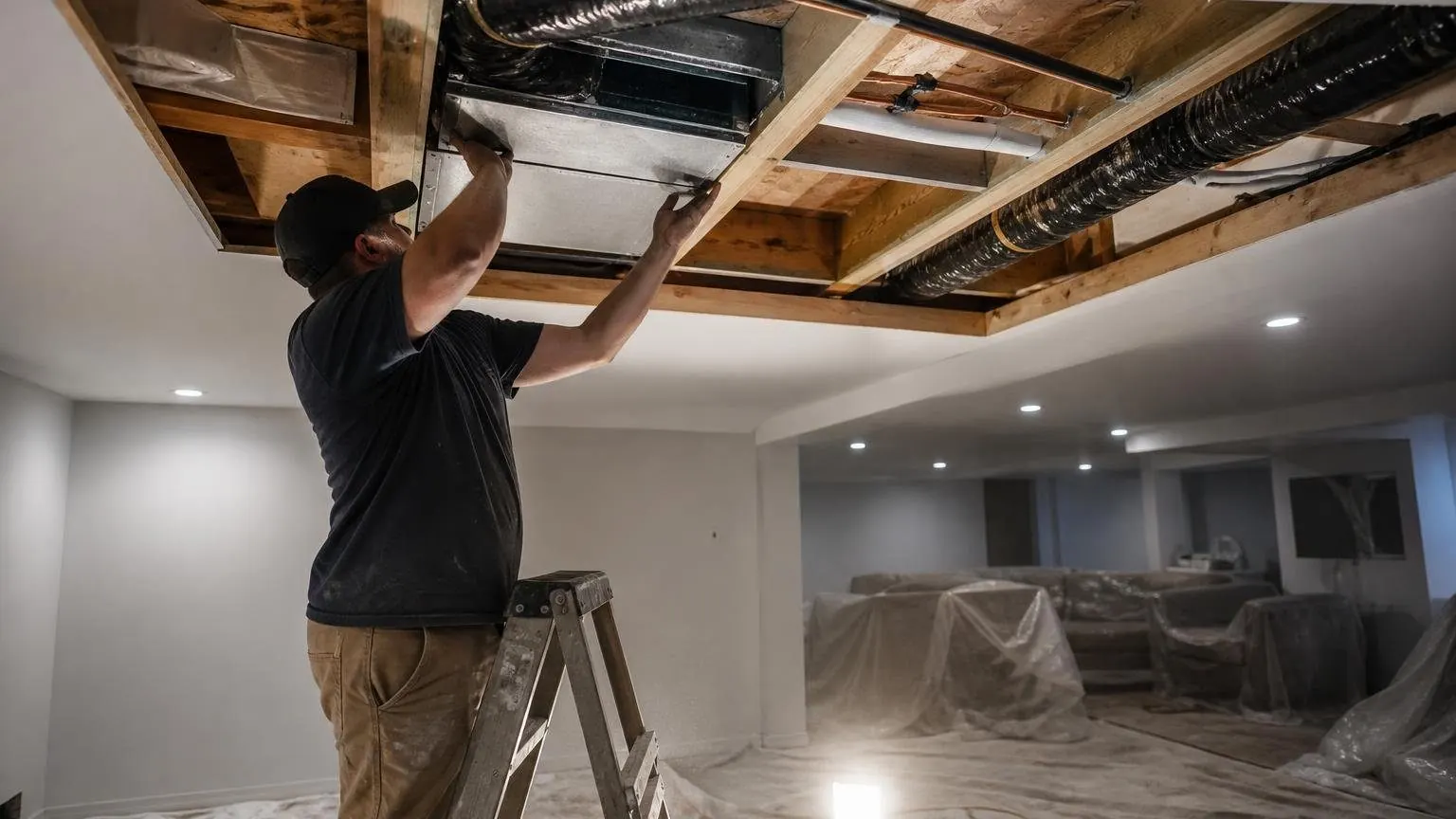
A ducted mini split is a mini split heat pump whose indoor unit hides in a ceiling, attic or closet and feeds a few rooms through short ducts. Equipment kits listed by Pioneer and Senville on November 12, 2026 cost $1,099.99 to $2,238 for 9,000 to 24,000 BTU before installation, and maker documents cap duct static pressure at 0.20 to 0.80 in. w.c.
Key Takeaways
- A 12,000 BTU class ducted kit listed at $1,413 (Pioneer, 11,000 BTU) and $1,399.99 (Senville) on November 12, 2026, equipment only (Pioneer, Senville).
- LG rates its LMU183HV multi-zone outdoor unit at 22.5 SEER2 with wall heads, 20.5 mixed and 18.5 with all ducted units (LG Multi F manual).
- Federal tests rate low-static ducted multi-split systems at 0.10 in. wc. minimum and mid-static ones at 0.30, against 0.50 for central systems (appendix M1, 2023).
- The Mitsubishi SEZ-KD18NA4 slim unit tops out at 0.20 in. WG; the SVZ-KP12NA air handler offers 0.80 (Mitsubishi submittals).
- One Mitsubishi SUZ-AA12NL outdoor unit rates 21.7 SEER2 with a wall head and 19.0 with a low-static ducted unit (ENERGY STAR list, October 18, 2026).
- No separate federal ducted class exists: split heat pumps made since 2023 need 14.3 SEER2 and 7.5 HSPF2 (10 CFR 430.32).
- ENERGY STAR Cold Climate needs HSPF2 8.1 for ducted splits and 8.5 for non-ducted (Version 6.2).
- In a DOE Building America test house, two ducted mini split systems leaked 21% and 16% of unit airflow (IBACOS, 2017).
What is a ducted mini split?
A ducted mini split is an inverter heat pump with a concealed indoor unit that serves one zone, or a few rooms, through a short duct system. The outdoor unit, line set and controls come from the same families as the wall heads in our explainer on how a ductless mini split works. Hiding that line set is part of the appeal, and running refrigerant lines in walls is allowed when no flare or quick connect joint sits behind the drywall and the suction line is insulated.
Makers sell three indoor styles, named for how much duct the fan can push against:
- Slim or low-static units, such as the Mitsubishi SEZ, built for a joist bay or soffit. The SEZ-KD18NA4 is 7-7/8 in. tall.
- Mid-static units, such as the Mitsubishi PEAD and Daikin FDMQ (9-5/8 in. tall), with stronger fans.
- Multi-position air handlers, such as the Mitsubishi SVZ, which mount upflow or horizontal.
How much does a ducted mini split cost?
The equipment alone runs about $1,100 to $2,300 for one ducted indoor unit and its outdoor unit in the 9,000 to 24,000 BTU range, going by the makers’ own web stores on November 12, 2026. Ductwork, grilles, the electrical circuit and labor come on top; our installed mini split cost figures cover that side.
| Size class | Pioneer Quantum Ultra ceiling concealed ducted, full set | Senville concealed duct (SENA/HF/ID) |
|---|---|---|
| 9,000 BTU | 9,500 BTU: $1,363 (listed regular price $1,949) | 9,000 BTU: $1,099.99 (out of stock) |
| 12,000 BTU | 11,000 BTU: $1,413 (regular $2,019) | 12,000 BTU: $1,399.99 |
| 18,000 BTU | 17,000 BTU: $1,753 (regular $2,499) | 18,000 BTU: $1,599.99 |
| 24,000 BTU | 22,000 BTU: $2,238 (regular $3,199) | 24,000 BTU: $1,799.99 |
Compiled by The HVAC Brief from Pioneer’s ducted collection (prices for the kit with the 10 ft line set) and Senville’s concealed duct listings, both observed November 12, 2026. Maker store prices, not a federal series; sale prices change often.
Read the capacity column, not the model name. Pioneer’s model numbers (RYT009, RYT012, RYT018 and RYT024) suggest 9,000 to 24,000 BTU, but its own specification lists rate cooling at 9,500, 11,000, 17,000 and 22,000 BTU per hour. Senville’s 24,000 BTU listing says the kit includes the indoor and outdoor units, controls and the chosen installation kit, while “Building-specific ductwork, supply and return grilles, drainage and electrical materials are provided as part of the professional installation.”
Ducted does not always cost more than ductless at the equipment stage. On Senville’s store the SENA/HF wall-mount kits list at the same $1,399.99, $1,599.99 and $1,799.99 as the concealed duct kits in the 12,000 to 24,000 BTU sizes. The extra cost of a ducted system sits in the duct runs, grilles and access panel.
What size ducted mini split do you need?
Size it from a room-by-room load calculation, not a square-foot chart. The ENERGY STAR National HVAC Design Report (Rev. 13) requires room loads from unabridged ACCA Manual J, Eighth Edition, and equipment selected per ACCA Manual S. Square-foot charts only give a starting range, and the two published ones below disagree.
| Capacity | ENERGY STAR room AC chart (8 ft ceiling) | Pioneer recommended room size, ducted Quantum Ultra |
|---|---|---|
| 9,000 to 9,500 BTU | 9,000 BTU: 350 up to 400 sq ft | 9,500 BTU: 250 to 350 sq ft |
| 11,000 to 12,000 BTU | 12,000 BTU: 450 up to 550 sq ft | 11,000 BTU: 350 to 500 sq ft |
| 17,000 to 18,000 BTU | 18,000 BTU: 700 up to 1,000 sq ft | 17,000 BTU: 500 to 750 sq ft |
| 22,000 to 24,000 BTU | 24,000 BTU: 1,400 up to 1,500 sq ft | 22,000 BTU: 750 to 1,000 sq ft |
Compiled by The HVAC Brief from the ENERGY STAR room air conditioner sizing chart and Pioneer’s product specifications (ducted collection), both read November 12, 2026.
ENERGY STAR’s chart is the federal one, but it was written for room air conditioners and assumes an 8 ft ceiling; it adds 10% for a very sunny room, subtracts 10% for a heavily shaded one and adds 600 BTU per occupant beyond two. Pioneer’s ranges for its ducted units are smaller per BTU, which fits a unit that also loses some capacity to duct runs. Our BTU calculator built on the ENERGY STAR chart gives the first estimate; a Manual J run settles it.
Low, medium or high static ducted mini split: which one do you need?
Pick the tier from the duct run: a low-static (slim) unit for one or two short runs in a joist bay or soffit, a medium-static unit for several rooms or a filter rack, and a high-static air handler for a full duct system. The maker numbers below set the limits.
| Tier | Federal definition (appendix M1) | Maker maximums we found | Typical duct job |
|---|---|---|---|
| Low static (slim duct) | At most 0.35 in. wc. at up to 400 cfm per ton; tested at 0.10 minimum | 0.20 (Mitsubishi SEZ-KD18NA4, LG LMDN097HV4); 0.36 (Fujitsu slim duct) | Short runs to one or two rooms from a soffit or ceiling |
| Medium static | 0.20 to 0.65 in. wc.; tested at 0.30 minimum | 0.60 (Mitsubishi PEAD-A24AA7); up to 0.6 (Daikin FDMQ) | Several rooms, longer runs, higher MERV filter |
| High static (multi-position air handler) | No separate mini split class; conventional ducted systems are rated at 0.50 | 0.80 (Mitsubishi SVZ-KP12NA) | A full duct system, upflow or horizontal |
HVAC Brief compilation of appendix M1 and the maker documents listed under Sources. “High static” is a maker and market label, not a federal term.
How much static pressure can a ducted mini split handle?
Most ducted mini splits are built for far less duct resistance than a furnace blower. The maker documents we read list maximum external static pressure from 0.20 in. of water column for slim units to 0.80 for a multi-position air handler, against the 0.50 in. wc. rating point for conventional central systems.
Federal rules draw the same line. Appendix M1 defines a low-static system as a ducted multi-split or multi-head mini split producing at most 0.35 in. wc. at up to 400 cfm per ton, and a mid-static one as 0.20 to 0.65. They are tested at minimums of 0.10 and 0.30, plus 0.08 if no filter is fitted. The current appendix points to AHRI 210/240-2024 for test details.
| Indoor unit (maker data) | Style | External static pressure, in. wc. |
|---|---|---|
| Mitsubishi SEZ-KD18NA4 | Low-static ducted | 0.02, 0.06, 0.14 or 0.20 |
| LG LMDN097HV4 | Low-static ducted, multi-zone | 0.10 rated; 0.00 to 0.20 |
| Fujitsu Airstage slim duct (ARUL, VRF line) | Slim duct | 0 to 0.36 |
| Mitsubishi PEAD-A24AA7 | Mid-static ducted | 0.14 to 0.60, five steps |
| Daikin FDMQ (0.75 to 2 tons) | Ducted concealed | Up to 0.6 |
| Mitsubishi SVZ-KP12NA | Multi-position air handler | 0.30, 0.50 or 0.80 |
Sources: Mitsubishi PEAD-A24AA7 submittal, Daikin FDMQ sheet (2018) and others in the source list.
These are maker figures for the model named, not independent tests. Our guide to measuring total external static pressure shows how a technician checks the real number with a manometer.
Why do ducted mini splits rate lower than ductless heads?
Ducted indoor units push air through ducts, grilles and a filter, so the fan works harder and the ratings show it. On the ENERGY STAR certified list, the Mitsubishi SUZ-AA12NL outdoor unit rates 21.7 SEER2 with its MSZ-EX12NL wall head but 19.0 with the SEZ-AD12NL low-static ducted unit. Mitsubishi also prints a separate fault table for each series, and the Mitsubishi mini split error codes range from lamp blink counts on wall heads to check codes on wired controllers.
| Indoor unit on SUZ-AA12NL | Style | SEER2 | HSPF2 |
|---|---|---|---|
| MSZ-EX12NL | Wall-mount | 21.7 | 10.0 |
| MLZ-KX12NL | One-way ceiling cassette | 20.7 | 10.0 |
| SLZ-AF12NL | Four-way ceiling cassette | 20.3 | 9.7 |
| PEAD-AA12NL | Mid-static ducted | 19.7 | 9.7 |
| MFZ-KX12NL | Floor-mount | 19.6 | 8.7 |
| SEZ-AD12NL | Low-static ducted | 19.0 | 9.6 |
| SVZ-AP12NL | Multi-position air handler | 18.4 | 9.7 |
Source: ENERGY STAR certified heat pump dataset, queried October 18, 2026.
Heating differs less: the ducted units hold 9.6 to 9.7 HSPF2 against the wall head’s 10.0, and the floor unit trails at 8.7. IBACOS, for DOE’s Building America program, wrote in 2017 that ductless indoor units “are typically less expensive and their rated efficiencies are higher” than ducted ones.
Correction
“Ducted mini split” is not its own federal efficiency class. The 2023 standard puts every split-system heat pump in one class with a 14.3 SEER2 and 7.5 HSPF2 minimum, wall head or concealed unit alike. See our explainer on SEER2 minimum requirements.
Ducted vs ductless mini split: which is better?
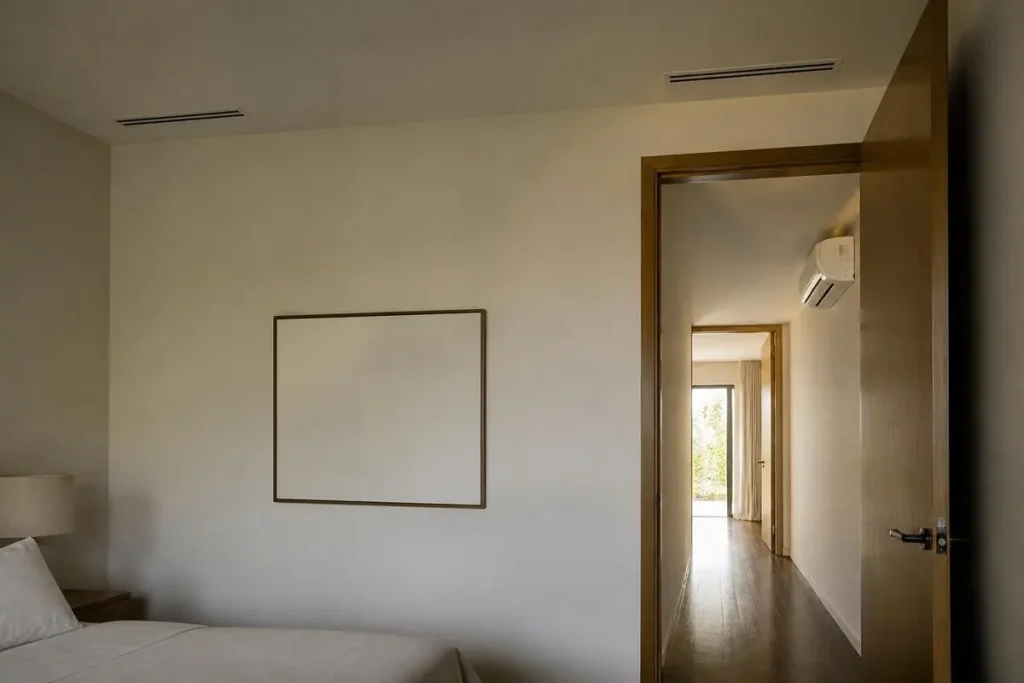
Ductless is better on rated efficiency and simplicity; ducted is better when you want no visible head or one unit serving several small rooms. On one Mitsubishi outdoor unit the wall head rates 21.7 SEER2 and the low-static ducted unit 19.0, a gap of about 12%.
A ducted mini split sits between the other two. It hides the equipment like a central system but keeps the inverter outdoor unit and small zone of a mini split. Fault reporting comes from the mini split side as well: Fujitsu RGLX ducted units appear in the same tables as its wall heads, and the Fujitsu mini split error codes are read by counting operation and timer lamp flashes.
| Factor | Ductless wall head | Ducted mini split | Central ducted heat pump |
|---|---|---|---|
| Indoor unit location | On the room wall | Ceiling, attic, soffit or closet | Basement, attic or closet |
| Federal rating static pressure | None (non-ducted) | 0.10 or 0.30 in. wc. minimum (multi-split, multi-head) | 0.50 in. wc. minimum |
| SEER2 on one SUZ-AA12NL outdoor unit | 21.7 | 19.0 to 19.7 | Different equipment |
| ENERGY STAR Cold Climate HSPF2 floor | 8.5 | 8.1 | 8.1 |
| LG LMU183HV multi-zone, SEER2 | 22.5 (all non-ducted) | 18.5 (all ducted); 20.5 mixed | Different equipment |
| Equipment price, Senville SENA/HF line, 12,000 BTU (Nov 12, 2026) | $1,399.99 wall mount | $1,399.99 concealed duct, plus ducts and grilles | Different equipment |
| What shows in the room | The indoor head on the wall | Supply and return grilles only | Supply and return grilles only |
| Rooms per indoor unit | One open area | Several small rooms through short ducts | Whole house |
Room layout decides a lot. IBACOS found ductless heads work best in open spaces, not bedrooms behind closed doors, so its test house paired four ductless heads with two ducted units for the bedrooms. Each indoor unit is its own zone, which replaces the dampers covered in our guide to HVAC zoning.
Can you mix ducted and ductless heads on one outdoor unit?
Yes, on most multi-zone outdoor units, as long as the maker lists the combination. Mixing changes the system rating: the outdoor unit is rated three ways, with all wall heads, all ducted units or a mix, and the mixed rating falls between the two.
| Outdoor unit (maker data) | All ductless | Mixed | All ducted |
|---|---|---|---|
| LG LMU183HV (Multi F), SEER2 | 22.5 | 20.5 | 18.5 |
| LG LMU183HV, rated cooling capacity, BTU/h | 18,000 | 17,600 | 17,200 |
| LG LMU243HV, SEER2 | 22.5 | 20.5 | 18.5 |
| Mitsubishi MXZ-SM42NAMHZ-U1, EER | 13.4 | 12.2 | 11.0 |
| Mitsubishi MXZ-SM42NAMHZ-U1, ENERGY STAR certified | Yes | No | No |
Compiled by The HVAC Brief from the LG Multi F and Multi F MAX engineering manual (Tables 8 and 9) and the Mitsubishi MXZ-SM42NAMHZ-U1 specification sheet.
LG’s manual says Multi F systems have a shared refrigerant circuit “field piped to multiple (ducted, non-ducted or mixed) indoor units” and that at least two indoor units must be connected. Mitsubishi says one multi-zone outdoor unit “can connect to up to eight ductless or ducted indoor units,” and its MXZ-SM42 sheet adds that a branch box is required to connect M- and P-Series indoor units.
Two limits come from the same sheet. The connected indoor capacity may reach 130% of the outdoor unit, but “the outdoor unit cannot provide more than 100% of the rated capacity,” and a ducted unit still has to meet its own static limit. Each head or ducted unit is its own zone, which is how a mixed system replaces the dampers in a conventional zoned duct system.
How should ducts be designed for a low-static mini split?
Design the ducts to the unit’s static limit, not the reverse. The ENERGY STAR National HVAC Design Report (Rev. 13) requires a duct system designed per ACCA Manual D and a design total external static pressure that includes external parts such as a MERV 6 or better filter.
- Run a room-by-room Manual J load and take design airflow from the maker’s expanded data; see our airflow per ton explainer.
- Pick the static tier first. A unit capped at 0.20 in. wc. leaves little for long runs.
- Subtract filter and grille losses from the rated static, then size each run with Manual D’s friction-rate method.
- Keep runs short and straight, and pull flex duct tight; sag adds resistance.
- Seal every joint and insulate ducts in unconditioned space.
- At startup, measure static pressure and room airflow against the design.
The Building America house shows why step 6 matters. IBACOS fitted no balancing dampers because “low static pressures are required for the ducted MSHP units to operate properly.” Bathroom 3 then got under 8 cfm against a 27 cfm design, while the master bathroom got 75 cfm against 9. The ducts leaked 21% and 16% of the 317 cfm nominal unit airflow, all inside conditioned space. Our walk-through of a mini split installation covers the refrigerant and condensate side.
Do ducted mini splits work in cold climates?
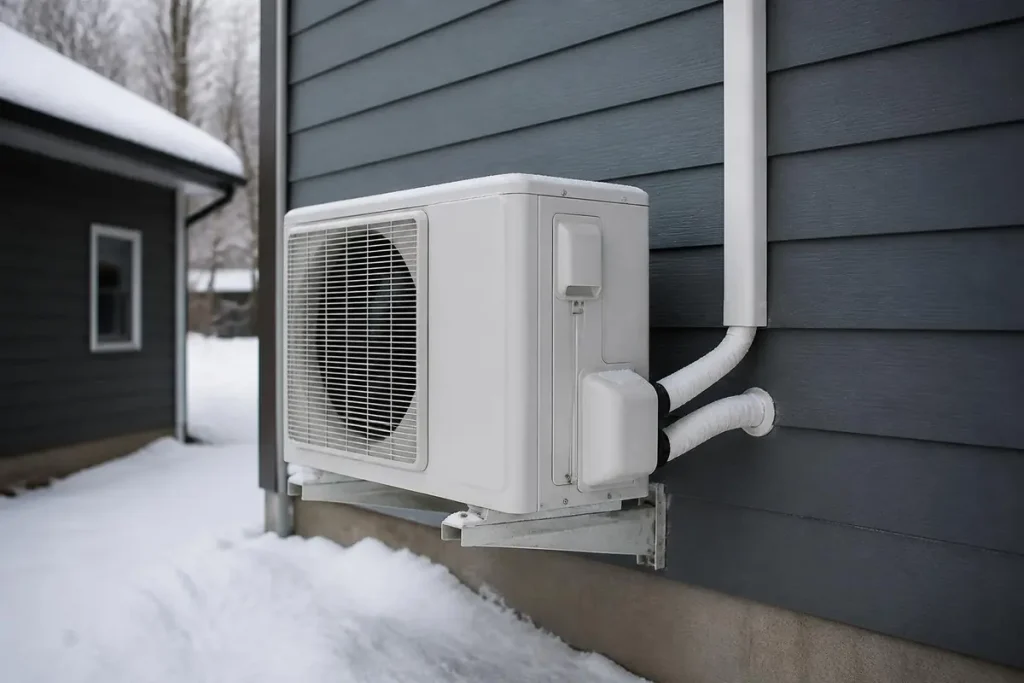
Yes. Ducted mini splits can earn cold climate labels, but programs set a lower heating bar for ducted units. ENERGY STAR’s Cold Climate tier needs HSPF2 of 8.1 for ducted splits against 8.5 for non-ducted, plus a COP of at least 1.75 at 5°F and 5°F capacity of at least 70% of the 47°F figure.
The NEEP cold climate specification (version 4.0, effective January 1, 2023) sets 7.7 HSPF2 for ducted systems against 8.5 for non-ducted, and lists “Singlezone Ducted, Compact Ducted” as its own configuration.
On the ENERGY STAR list, the SUZ-AA12NLHZ outdoor unit carries the Cold Climate flag with every indoor style. It rates 17.6 SEER2 with the MSZ-EX12NL wall head, 17.0 SEER2 and 9.5 HSPF2 with the PEAD-AA12NL, 16.2 and 9.4 with the SEZ-AD12NL, and 16.1 and 9.3 with the SVZ-AP12NL. Our cold climate heat pump guide explains the 5°F test point.
Are ducted mini splits worth it? The pros and cons
A ducted mini split is worth it when hidden equipment or a cluster of closed rooms matters more than the last point of rated efficiency, and when the installer will actually design the ducts.
- Pros: only grilles show; one indoor unit can serve several small rooms; Daikin says the FDMQ’s 0.6 in. rating allows high MERV filters.
- Cons: lower rated SEER2 than a wall head; tight static limits; ducts need design, sealing and a service access panel.
We publish no installed price, because no federal or national-lab series covers ducted mini splits; the equipment prices above are maker store listings. Our mini split cost analysis sets out the federal numbers that do exist.
How we researched this
Research date: October 18, 2026. We read appendix M1 and 10 CFR 430.32 from eCFR, the ENERGY STAR specification and design report, NEEP’s specification and the IBACOS report, and queried the ENERGY STAR certified dataset directly. Static figures come from Mitsubishi, Daikin, Fujitsu and LG documents, labelled as maker data.
A PNNL research tracker entry on ducted mini splits had no published results. Excluded: contractor and lead-generation price ranges and forums. We did not use Reddit.
November 12, 2026 update: we added equipment prices read from the Pioneer and Senville web stores (maker listings, dated, not a federal series), the ENERGY STAR room air conditioner sizing chart, Pioneer’s recommended room sizes, the ENERGY STAR National HVAC Design Report’s Manual J and Manual S requirement, and mixed ducted and ductless ratings from LG’s Multi F engineering manual and Mitsubishi’s MXZ-SM42NAMHZ-U1 sheet. Installed prices still come only from our mini split cost page.
Frequently asked questions
Can a mini split be ducted?
Yes. Makers sell concealed ducted indoor units for the same outdoor units used with wall heads. On the ENERGY STAR list, the Mitsubishi SUZ-AA12NL is certified with seven indoor styles, including two ducted units and an air handler. Check the maker’s pairing list before mixing styles on a multi-zone outdoor unit.
Are ducted mini splits worth it?
They are worth it when hiding the equipment or serving several closed rooms matters more than peak efficiency. The rating penalty is modest: on one Mitsubishi outdoor unit, the low-static ducted pairing rates 19.0 SEER2 against 21.7 for the wall head, per ENERGY STAR.
How much does a ducted mini split cost?
For equipment, Pioneer listed its ducted kits at $1,363 to $2,238 (9,500 to 22,000 BTU) and Senville at $1,099.99 to $1,799.99 (9,000 to 24,000 BTU) on November 12, 2026. Ducts, grilles, wiring and labor are extra, and no federal series publishes an installed price for ducted mini splits.
How many square feet does a 12,000 BTU ducted mini split cover?
ENERGY STAR’s room air conditioner chart puts 12,000 BTU at 450 up to 550 sq ft; Pioneer recommends its 11,000 BTU ducted unit for 350 to 500 sq ft. The ENERGY STAR National HVAC Design Report requires a room-by-room Manual J load for an exact answer.
Can a ducted mini split use existing ductwork?
Only if the old ducts fit the unit’s static limit. Ducts sized for a central system rated at 0.50 in. wc. can choke a slim unit capped at 0.20 in. WG. Measure static pressure and airflow first; mid-static units (up to 0.60) and air handlers (up to 0.80) tolerate more resistance.
Can a ducted mini split heat a whole house?
A multi-position mini split air handler can serve a small or low-load house through a full duct system, and federal rules treat it like any split heat pump, with a 14.3 SEER2 minimum. A Manual J load decides whether one unit is enough; our guide to air handler installation covers placement.
What is a slim duct mini split?
It is a thin concealed indoor unit made for short runs in a ceiling or soffit. The Mitsubishi SEZ-KD18NA4 is 7-7/8 in. tall and allows 0.02 to 0.20 in. WG of external static pressure. LG’s LMDN097HV4 is rated at 0.10 in. wc. at its factory setting, with a 0.20 maximum.
Sources
- eCFR. “10 CFR 430 Subpart B, Appendix M1 (January 1, 2023 edition).” https://www.ecfr.gov/on/2023-01-01/title-10/chapter-II/subchapter-D/part-430/subpart-B/appendix-Appendix%20M1%20to%20Subpart%20B%20of%20Part%20430. Accessed October 2026.
- eCFR. “10 CFR 430 Subpart B, Appendix M1 (current).” https://www.ecfr.gov/current/title-10/chapter-II/subchapter-D/part-430/subpart-B/appendix-Appendix%20M1%20to%20Subpart%20B%20of%20Part%20430. Accessed October 2026.
- eCFR. “10 CFR 430.32, Energy and water conservation standards.” https://www.ecfr.gov/current/title-10/chapter-II/subchapter-D/part-430/subpart-A/section-430.32. Accessed October 2026.
- ENERGY STAR. “Version 6.2 Central Air Conditioner and Heat Pump Specification (Rev. March 2025).” https://www.energystar.gov/sites/default/files/2025-04/ENERGY%20STAR%20Version%206.2%20Heat%20Pump%20Specification%20Rev.%20March%202025.pdf. Accessed October 2026.
- ENERGY STAR. “Certified Air Source Heat Pumps (dataset).” https://data.energystar.gov/Active-Specifications/ENERGY-STAR-Certified-Air-Source-Heat-Pumps/w7cv-9xjt. Queried October 18, 2026.
- ENERGY STAR. “National HVAC Design Report, Rev. 13.” https://www.energystar.gov/sites/default/files/asset/document/National%20HVAC%20Design%20Report_Rev%2013.pdf. Accessed November 2026.
- NEEP. “Cold Climate Air Source Heat Pump Specification (Version 4.0).” https://neep.org/sites/default/files/media-files/cold_climate_air_source_heat_pump_specification_-_version_4.0_final.pdf. Accessed October 2026.
- IBACOS for DOE Building America. “Mini-Split Heat Pump Evaluation and Zero Energy Ready Home Support.” January 2017. https://www1.eere.energy.gov/buildings/publications/pdfs/building_america/64855.pdf. Accessed October 2026.
- Mitsubishi Electric. “Submittal Data: SEZ-KD18NA4 and SUZ-KA18NA.” https://resource.gemaire.com/is/content/Watscocom/Gemaire/mitsubishi_sez-kd18na4th_article_1369225212955_en_subs.pdf?fmt=pdf. Accessed October 2026.
- Mitsubishi Electric. “Submittal: PEAD-A24AA7 and PUZ-A24NHA7.” https://resource.gemaire.com/is/content/Watscocom/Gemaire/mitsubishi_pead-a24aa7_article_1494405100672_en_subs.pdf?fmt=pdf. Accessed October 2026.
- Mitsubishi Electric. “Submittal Data: SVZ-KP12NA and SUZ-KA12NAR1.” https://resource.gemaire.com/is/content/Watscocom/Gemaire/mitsubishi_svz-kp12na_article_680253997332963_en_subs.pdf?fmt=pdf. Accessed October 2026.
- Daikin. “FDMQ Ducted Concealed Specification Sheet (PF-FDMQSZ 03-18).” https://resource.ecmdi.com/is/content/Watscocom/Gemaire/daikin_rx09rmvju_article_11550863967322462_en_ss.pdf. Accessed October 2026.
- Fujitsu General. “Airstage Indoor Unit Slim Duct.” https://www-origin.fujitsugeneral.com/us/products/vrf/indoor/duct/arul.html. Accessed October 2026.
- Pioneer. “Ducted Split System” collection and Quantum Ultra ceiling concealed product specifications. https://www.pioneerminisplit.com/collections/ducted. Prices observed November 12, 2026.
- Senville. “Concealed Duct: Mini Split Systems.” https://senville.com/mini-split-ac/concealed-duct/. Prices observed November 12, 2026.
- Senville. “Mini Split Air Conditioners.” https://senville.com/mini-split-ac/. Prices observed November 12, 2026.
- Senville. “24000 BTU Concealed Duct Air Conditioner, Heat Pump (SENA/24HF/ID).” https://senville.com/24000-btu-concealed-duct-air-conditioner-heat-pump-sena-24hf-id/. Accessed November 2026.
- ENERGY STAR. “Room Air Conditioners: sizing chart.” https://www.energystar.gov/products/room_air_conditioners. Accessed November 2026.
- LG Electronics. “Multi F and Multi F MAX Heat Pump System Engineering Manual.” https://media.us.lg.com/m/517abea3d0d7e0a5/original/EM_MultiFODU_3HV_1HV-pdf.pdf. Accessed November 2026.
- Mitsubishi Electric Trane HVAC. “Multi-zone Heat Pump: MXZ.” https://www.mitsubishicomfort.com/products/m-series/mxz. Accessed November 2026.
- Mitsubishi Electric. “Specifications: MXZ-SM42NAMHZ-U1.” https://www.acdirect.com/media/specs/Mitsubishi/mitsubishi-mxz-sm42-hyper-heat-specifications-sheet.pdf. Accessed November 2026.
- LG Electronics. “LMDN097HV4 Multi F Ceiling-Concealed Low-Static Duct (2023).” https://media.us.lg.com/m/14f51e37efa8ea77/original/SB_MultiF_LowStaticDucted_LMDN097HV4-pdf.pdf. Accessed October 2026.
Leave a Reply