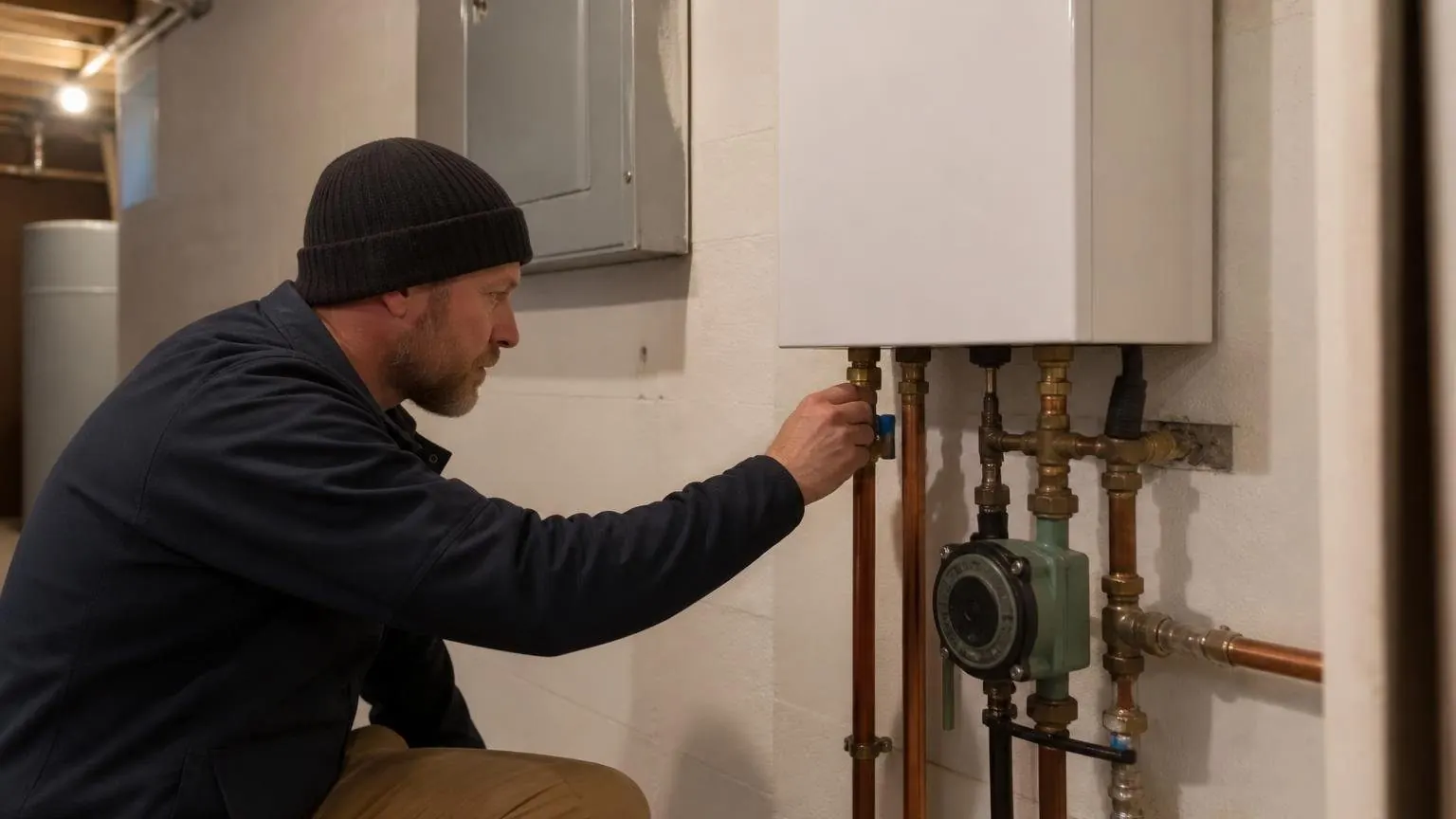
What is an electric boiler? An electric boiler heats hydronic system water with resistance elements instead of a burner, so it needs no flue or gas line. Each kW yields 3,412 Btu per hour, but at October 2026 forecast prices its heat costs about 3.3 times a gas boiler’s. No federal efficiency floor, ENERGY STAR label or 2026 tax credit applies to one.
Key Takeaways
- Federal rules set no AFUE minimum for electric hot water boilers; gas-fired hot water boilers must reach 84% (10 CFR 430.32).
- At EIA’s October 2026 forecast of 18.28 cents per kWh, electric boiler heat costs $53.56 per million Btu versus $16.45 from an 84% gas boiler (EIA STEO, our arithmetic).
- A heat pump needs a seasonal COP of 3.26 to match that gas boiler, but only 1.63 to beat an 84% propane boiler.
- Argo’s 18 kW AT1854 draws 75.0 amps on 240 V and needs a 93.8 amp minimum circuit ampacity (Argo AT manual).
- On 208 V the same boiler makes 46,100 Btu/h instead of 61,400.
What is an electric boiler?
An electric boiler is a hydronic heater that turns electricity into heat inside a small water vessel; a circulator then pumps that water to baseboard, radiators, a radiant floor or a fan coil. With no combustion, there is no chimney and no flue gas.
DOE describes boilers as heating water for baseboard radiators, radiant floors or a coil (DOE Energy Saver, archived copy). The piping and emitters match any hot water heating system; only the heat source changes.
Electro Industries lists wall hung models from 1.1 to 36 kW across its Mini EZBoiler and EZB-T1 lines, up to 122,800 Btu/h (Electro Industries, maker claim). Unlike a combi boiler, Argo’s AT pairs with an indirect tank for domestic hot water rather than heating tap water on demand.
EIA’s 2020 housing survey counts 9.29 million US homes heated mainly by steam or hot water, 6.51 million of them on natural gas, but publishes no separate electric boiler count (EIA RECS 2020, Table HC6.1).
How does an electric boiler heat water?
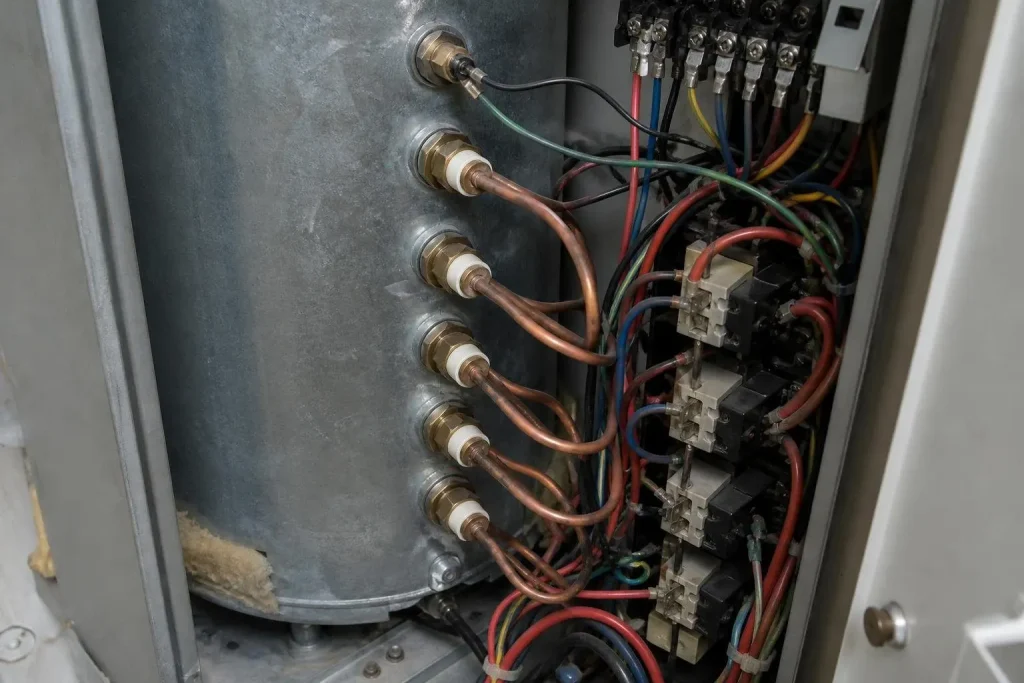
Current flows through sheathed resistance elements immersed in the water, and a control board stages those elements on as demand rises. An electric furnace stages its elements the same way, and an electric furnace that is not heating often has a stage that never came on, leaving the blower moving lukewarm air. Argo’s manual gives the rating rule: kilowatts times 3,412 equals Btu per hour of heat (Argo AT Series IOM, Rev. B, 2025).
Per the Argo manual, a call for heat runs like this:
- The thermostat closes and the board starts the circulator.
- The board reads supply water temperature and fires the first element.
- More elements stage on if needed; Argo’s AT Series C rotates the starting element.
- At set point, elements drop out and the pump runs a post purge.
The Argo AT adjusts from 90 to 180 F, covering both radiant floor slabs and fin tube baseboard.
What federal efficiency rules apply to an electric boiler?
No federal minimum efficiency applies to an electric boiler. 10 CFR 430.32(e)(2) lists the AFUE for electric hot water and steam boilers as “None”; gas-fired hot water boilers built since January 15, 2021 need 84%, and oil-fired ones 86%.
Electric hot water boilers must cap standby and off mode power at 8 watts and include automatic water temperature adjustment that holds boiler water at or below 140 F when there is no inferred heat load.
Correction: “100% efficient” is a maker claim, not a federal rating. DOE puts the AFUE of an all-electric boiler “between 95% and 100%,” lower for outdoor units with jacket loss (DOE, archived copy). Efficiency at the boiler does not lower the price of a kilowatt hour. The same tradeoff shows up outdoors: among pool heater types, a heat pump costs far less to run than gas in mild air, while gas heats fastest in any weather.
Is there an ENERGY STAR electric boiler?
No. ENERGY STAR does not certify electric boilers, so no electric model can carry the label. The ENERGY STAR Boilers Version 3.0 specification (Rev. January 2024) defines an eligible residential boiler as “a self-contained fuel burning appliance” with input under 300,000 Btu/h. Its performance table has two rows: gas at 90% AFUE and oil at 87%. An electric boiler burns no fuel, so it falls outside the scope.
The specification also excludes boilers “intended only for commercial applications” and any boiler rated at 300,000 Btu/h or more. A listing that calls an electric boiler “ENERGY STAR rated” is describing something the program does not offer.
What efficiency rating does an electric boiler have?
None that a federal rule sets. The residential standard in 10 CFR 430.32 lists “None” for electric boilers, as covered above. The commercial rule is no different. 10 CFR 431.87 sets thermal or combustion efficiency floors for commercial packaged boilers of 300,000 Btu/h and up, and every class in its table is gas-fired or oil-fired: 80.0% thermal efficiency for a gas hot water boiler up to 2,500,000 Btu/h, 82.0% for oil. There is no electric row. 300,000 Btu/h equals 87.9 kW (300,000 ÷ 3,412, our arithmetic), so an electric boiler for a commercial building has no federal efficiency floor either.
The number that matters is output at your supply voltage, from the maker’s rating table. On a 208 V commercial service, Argo’s 24 kW AT2446 makes 61,600 Btu/h, not its 81,900 Btu/h rating at 240 V.
Does an electric boiler qualify for a federal tax credit?
No, and in 2026 no boiler does. The Energy Efficient Home Improvement Credit (25C) for hot water boilers covered natural gas, propane and oil models only. Gas boilers needed ENERGY STAR certification and at least 95% AFUE, and the credit was 30% of cost up to $600 (ENERGY STAR). It applied to products “purchased and installed between January 1, 2023, and December 31, 2025.” The IRS states the same end date for the whole credit, which also covered heat pumps. A boiler installed this year earns no federal credit. Utility rebates are separate and vary by utility.
What size electric boiler do you need?
Size an electric boiler from a room by room heat loss calculation, not radiator counts or floor area: divide design heat loss in Btu/h by 3,412 and pick the next model up. Argo’s manual cites the Hydronics Institute H-22 method and warns against oversizing for radiant floors. Where a heated garage sits on the boiler loop, its door belongs in that calculation, and the garage door insulation data show a foam insulated sectional door conducting a small fraction of the heat a bare steel door does.
Worked example. A heat loss calculation (our heating load estimator is a starting point) puts a house at 55,000 Btu/h at design temperature.
- Convert: 55,000 ÷ 3,412 = 16.1 kW.
- Compare: Argo’s 16 kW AT1644 makes 54,600 Btu/h, just short; the 18 kW AT1854 makes 61,400.
- Check voltage: on 208 V the AT1854 makes 13,520 watts, or 46,100 Btu/h, too little.
- Choose the 18 kW model on 240 V, or a larger one on 208 V.
| Argo AT model | kW at 240 V | Btu/h at 240 V | Btu/h at 208 V | Amps at 240 V | Min. circuit ampacity | Max. overcurrent |
|---|---|---|---|---|---|---|
| AT0623 | 6 | 20,500 | 15,400 | 25.0 | 31.3 | 40 |
| AT1025 | 10 | 34,100 | 25,600 | 41.7 | 52.1 | 60 |
| AT1644 | 16 | 54,600 | 41,000 | 66.7 | 83.3 | 100 |
| AT1854 | 18 | 61,400 | 46,100 | 75.0 | 93.8 | 100 |
| AT2446 | 24 | 81,900 | 61,600 | 100.0 | 125.0 | 125 |
Source: Argo AT Series IOM Rev. B (September 9, 2025), Table 1. Maker ratings.
Resistance output falls with the square of voltage: (208 ÷ 240)² is about 0.75, so every 208 V rating drops by roughly a quarter. Confirm the supply voltage before sizing. The same loss hits baseboard heaters wired to a lower supply than their nameplate, and electric baseboard heater not working checks the voltage before blaming the element when a heater runs warm but weak. Supply voltage also changes the thermostat hookup: baseboard heater thermostat wiring covers why the white wire is taped black as a second hot on the higher voltage circuit, while on the lower one the neutral runs straight past the thermostat.
How many amps does an electric boiler need?
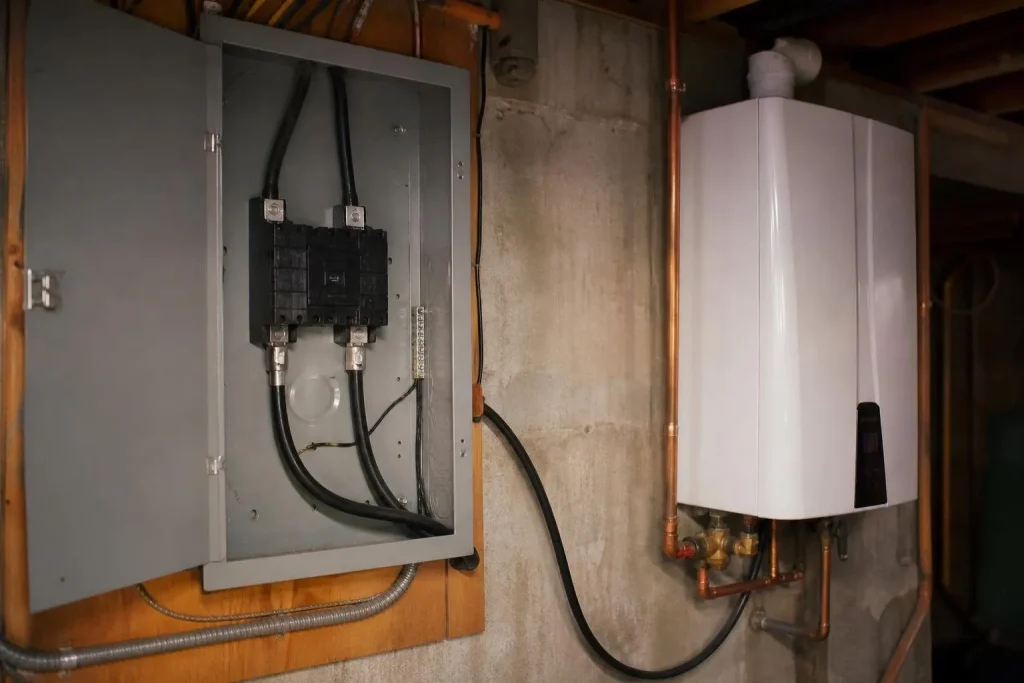
Amps equal watts divided by volts: 18,000 ÷ 240 = 75 amps, matching Argo’s AT1854 listing. Argo then lists a 93.8 amp minimum circuit ampacity (125% of 75, our arithmetic) and a 100 amp maximum breaker, plus the circulator’s amps.
That 93.8 amp circuit is close to half of a 200 amp service before the range, dryer and air conditioner are counted. Argo’s manual says wire and breakers must follow the National Electrical Code; an electrician’s load calculation and your local inspector decide whether the panel needs an upgrade.
A boiler breaker that trips repeatedly signals a fault; see why HVAC breakers trip. Our watts to amps reference applies the same math to other equipment.
What piping and safety controls does an electric boiler need?
An electric boiler needs the same closed-loop hardware as any hot water boiler, plus a guaranteed flow of water past its elements. Elements that fire with no water or no flow burn out. Argo’s AT Series manual (Rev. B, 2025) sets these rules:
- Relief valve: the supplied valve limits working pressure to 30 psi. It mounts vertically and discharges within 6 inches of the floor.
- Fill and running pressure: fill the system to 10 to 15 psig. Pressure rises as the water heats and must stay under 25 psig.
- Flow: the minimum flow rises with size, from 2.0 gpm for the 6 kW model to 8.2 gpm for the 24 kW, based on a 20°F rise. Argo calls for primary/secondary or series-loop piping, with no zone valve that can block flow through the boiler. Return enters at the bottom; reverse flow “will cause very early element failure.”
- Low water cutoff: required when the boiler sits above the radiation. The control’s dry fire test “is not a substitute for a low water cutoff.”
- Air vents: at the system high points, to shorten start-up and avoid element burnout.
- Antifreeze: propylene glycol made for hydronic systems only, at 40% or less. No plumbing or automotive glycol.
Watch the gauge. Argo says pressure that keeps rising and falling over the season points to a fill valve leak, a system leak or a compression tank failure. Our guide to boiler expansion tank pressure, sizing and failure signs covers how to test the tank’s air charge and size a replacement.
The control enforces its own sequence. The pump runs 30 seconds before any element energizes. Elements stay off at least 3 minutes after a cycle ends. If the flow switch or low water cutoff opens mid-cycle, every element shuts off and the display shows FLO or LCO.
The board also has load management terminals. Argo says some utilities use them to switch the boiler to standby during peak demand. When they open, the call for heat moves to a set of auxiliary contacts that can start a backup heater. If your utility offers an off-peak or interruptible heating rate, ask whether it connects to these terminals.
How much does an electric boiler cost to run vs a gas boiler or heat pump?
Electric boiler heat costs about $53.56 per million Btu at EIA’s October 2026 forecast of 18.28 cents per kWh, roughly 3.3 times the $16.45 from a gas boiler at the 84% federal minimum. On the September outlook, heat from an oil furnace costs about $46.10 per million Btu, closer to electric resistance heat at $53.37 than to a gas furnace at $16.43, according to our outlook for heating fuel costs this winter.
We averaged EIA’s monthly residential forecasts for October 2026 to March 2027 (Short-Term Energy Outlook) and converted with EIA heat content factors: 3,412 Btu per kWh, 1,036 per cubic foot of gas, 91,452 per gallon of propane and 138,500 per gallon of oil. The method matches our cost of heat by fuel index.
| Heat source | Efficiency basis | Forecast price | Per million Btu delivered |
|---|---|---|---|
| Gas boiler | 84% AFUE (federal minimum) | $14.32 per thousand cu ft | $16.45 |
| Air-to-water heat pump | Seasonal COP 3.0 (assumed) | 18.28 cents per kWh | $17.85 |
| Air-to-water heat pump | Seasonal COP 2.0 (assumed) | 18.28 cents per kWh | $26.78 |
| Propane boiler | 84% AFUE (assumed, same as gas) | $2.52 per gallon | $32.78 |
| Air-to-water heat pump | Seasonal COP 1.5 (assumed) | 18.28 cents per kWh | $35.71 |
| Oil boiler | 86% AFUE (federal minimum) | $5.43 per gallon | $45.55 |
| Electric boiler | 100% (no federal minimum) | 18.28 cents per kWh | $53.56 |
Our arithmetic on EIA STEO October 2026 national averages. Your utility rate will differ; see residential electricity prices by state.
A heat pump needs a seasonal COP of 3.26 to match the 84% gas boiler, but only 1.63 to match an 84% propane boiler, so the math differs sharply in homes heated with propane. DOE says heat pumps “easily cut electricity use by 50%” versus resistance heat, equal to COP 2.0 (DOE, archived copy).
Field results depend on water temperature. A Minnesota study of four air-to-water installations projected 27% to 50% heating energy savings but warned that radiators designed for 160 F and up may struggle in cold weather (CEE fact sheet, 2024). At full output an 18 kW electric boiler costs $3.29 an hour at 18.28 cents.
When does an electric boiler make sense?
An electric boiler fits small loads, homes without gas and backup duty. As sole heat for a large cold-climate house it rarely pays: DOE calls all-electric boilers “an uneconomic choice” in most of the country and points to heat pumps. For a house that keeps its radiators or floor loops, the heat pump in question is an air to water heat pump, which can replace or back up a boiler. Electric furnaces are far more common than electric boilers, serving as the main heating equipment in 13.82 million homes, per our breakdown of US home heating by fuel and equipment.
| Situation | Electric boiler | Gas boiler | Air-to-water heat pump |
|---|---|---|---|
| No gas line, small load | Good fit: no venting, compact | Needs gas service and a flue | Good fit if budget allows |
| Existing 180 F cast iron radiators | Reaches 180 F | Reaches 180 F | Radiators designed for 160 F and up may struggle |
| Electrical service | Up to 125 A circuit (24 kW Argo) | Controls and pump only | Varies by model |
Replacing an oil or gas boiler? Our boiler replacement guide covers the venting and piping changes. Homes with ducts have a parallel resistance option, the electric furnace. Argo markets the AT as ideal for radiant systems.
How we researched this
Research date: October 9, 2026. We read 10 CFR 430.32 as in force October 1, 2026, the monthly forecasts in EIA’s October 2026 Short-Term Energy Outlook workbook, and the electrical tables in Argo’s AT manual (Rev. B, September 2025). Costs per million Btu are our arithmetic, inputs shown.
Cited: the ten sources below. Excluded: vendor installed-price surveys and contractor cost pages (no federal series exists), a superseded 2011 Thermolec manual, and UK guides priced in pence. Heat pump COPs are stated assumptions. Reddit was skipped because the topic involves electrical service.
Frequently asked questions
Are electric boilers expensive to run?
Yes, in most of the US. At EIA’s October 2026 forecast of 18.28 cents per kWh, heat from an electric boiler costs $53.56 per million Btu, versus $16.45 from a gas boiler at the 84% AFUE minimum. An 18 kW boiler at full output costs about $3.29 an hour.
Can I size an electric boiler by square footage?
No. Floor area ignores insulation, windows and climate. Calculate design heat loss in Btu per hour, divide by 3,412 to get kilowatts, and choose the next listed model. Argo’s manual cites the Hydronics Institute H-22 method and warns against oversizing, especially for in-floor radiant heat.
Does an electric boiler need a 200 amp service?
Often it needs a large share of one. Argo lists its 18 kW model at 75.0 amps on 240 V with a 93.8 amp minimum circuit ampacity, and its 24 kW model at 100.0 amps with a 125 amp circuit. An electrician’s load calculation under the National Electrical Code and local rules decides whether your panel can carry it.
Does an electric boiler need a chimney or venting?
No. There is no combustion, so there is no flue. DOE notes that an all-electric furnace or boiler has no flue loss through a chimney and rates its AFUE between 95% and 100%, with lower values for outdoor units. Manufacturer clearances still apply.
Is an electric boiler better than an air-to-water heat pump?
On running cost, rarely. At October 2026 forecast prices a heat pump at a seasonal COP of 2.0 delivers heat at $26.78 per million Btu, half the electric boiler’s $53.56. A Minnesota field study projected 27% to 50% heating energy savings for air-to-water systems.
Will an electric boiler work on 208 volts?
Yes, but with less heat. Resistance output scales with the square of voltage, so a 240 V rated boiler makes about 75% of its rating at 208 V. Argo’s 18 kW AT1854 drops from 61,400 to 46,100 Btu per hour.
Are electric boilers ENERGY STAR certified?
No. The ENERGY STAR Boilers Version 3.0 specification covers only fuel-burning residential boilers under 300,000 Btu/h, with minimums of 90% AFUE for gas and 87% for oil. Electric boilers fall outside its scope, so no electric model can carry the label.
Can I get a federal tax credit for an electric boiler?
No. The 25C hot water boiler credit covered only natural gas, propane and oil boilers, gas models at 95% AFUE or more, worth 30% of cost up to $600. It applied to equipment purchased and installed through December 31, 2025, so no boiler installed in 2026 qualifies.
Sources
- Electronic Code of Federal Regulations. “10 CFR 430.32, Energy and water conservation standards and their compliance dates.” https://www.ecfr.gov/current/title-10/chapter-II/subchapter-D/part-430/subpart-C/section-430.32. Accessed October 2026.
- U.S. Energy Information Administration. “Short-Term Energy Outlook, October 2026, monthly data (Table 2, Energy Prices).” https://www.eia.gov/outlooks/steo/xls/STEO_m.xlsx. Accessed October 2026.
- U.S. Energy Information Administration. “British thermal units (Btu).” https://www.eia.gov/energyexplained/units-and-calculators/british-thermal-units.php. Accessed October 2026.
- U.S. Energy Information Administration. “RECS 2020, Table HC6.1, Space heating in U.S. homes.” https://www.eia.gov/consumption/residential/data/2020/hc/pdf/HC%206.1.pdf. Accessed October 2026.
- U.S. Department of Energy, Energy Saver. “Furnaces and Boilers” (archived copy). https://web.archive.org/web/2025id_/https://www.energy.gov/energysaver/furnaces-and-boilers. Accessed October 2026.
- U.S. Department of Energy, Energy Saver. “Electric Resistance Heating” (archived copy). https://web.archive.org/web/2025id_/https://www.energy.gov/energysaver/electric-resistance-heating. Accessed October 2026.
- ECR International / Argo. “AT Series Electric Hot Water Boilers, Installation, Operation and Maintenance Manual, PN 240013676 Rev. B.” https://www.argocontrols.com/sites/default/files/240013676%20AT%20SERIES%20IOM%20Rev%20B%20Eng%20Fr.pdf. Accessed October 2026.
- Argo. “AT Series C Electric Boiler.” https://www.argocontrols.com/products/boilers-electric/series-c-electric-boiler. Accessed October 2026.
- Electro Industries. “Electric Boiler.” https://electromn.com/electric-boiler/. Accessed October 2026.
- Center for Energy and Environment. “Field Study of Cold Climate Air-to-Water Heat Pumps, Fact Sheet.” https://www.mncee.org/sites/default/files/report-files/187286_CEE_CARD-AWHP_factsheet.pdf. Accessed October 2026.
- U.S. Environmental Protection Agency, ENERGY STAR. “ENERGY STAR Program Requirements, Product Specification for Boilers, Eligibility Criteria Version 3.0, Rev. January 2024.” https://www.energystar.gov/sites/default/files/2026-09/ENERGY%20STAR%20Boilers%20Version%203.0%20Specification%20Rev%20January%202024.pdf. Accessed November 2026.
- Electronic Code of Federal Regulations. “10 CFR 431.87, Energy conservation standards and their effective dates (commercial packaged boilers).” https://www.ecfr.gov/current/title-10/chapter-II/subchapter-D/part-431/subpart-E/section-431.87. Accessed November 2026.
- U.S. Environmental Protection Agency, ENERGY STAR. “Hot Water Boilers (Natural Gas, Propane, Oil) Tax Credit.” https://www.energystar.gov/about/federal-tax-credits/hot-water-boilers-natural-gas-propane-oil. Accessed November 2026.
- Internal Revenue Service. “Energy Efficient Home Improvement Credit.” https://www.irs.gov/credits-deductions/energy-efficient-home-improvement-credit. Accessed November 2026.
Leave a Reply