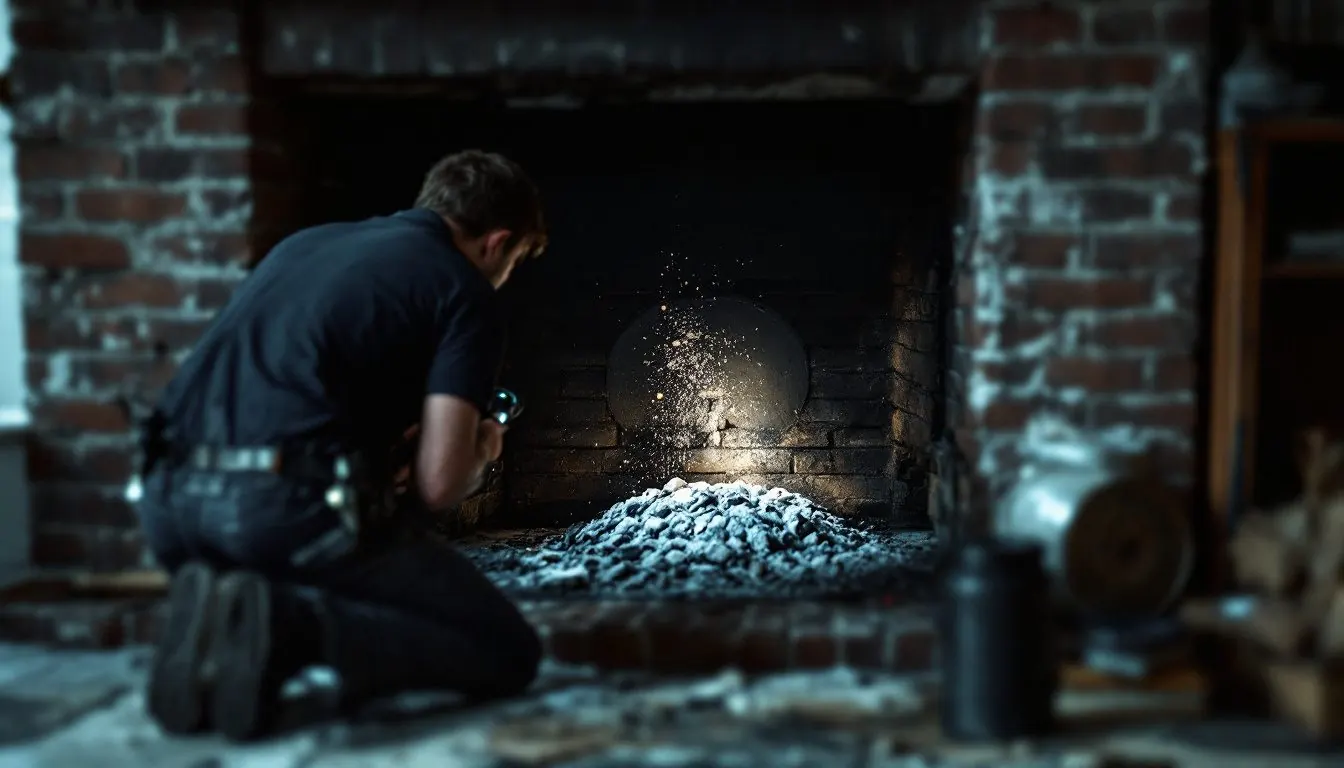
Should a fireplace damper be open or closed? Open whenever wood, embers or gas logs are burning, and tightly closed the rest of the time. DOE says a burning traditional fireplace can pull up to 300 cubic feet per minute of heated room air up the chimney, and closing the damper on warm embers risks carbon monoxide indoors.
When is it safe to close the fireplace damper after a fire?
Only when the fire is out and the embers are cold. New Jersey’s Division of Fire Safety says: “Do not close the damper before the fire has died out and the embers are cold” (New Jersey fact sheet). Fairfax County Fire and Rescue says keep it open “until the ashes are cool” to avert a buildup of carbon monoxide.
A dying fire is the weak moment. The DOE Building America Solution Center says that when a fire has burned down, “a small kitchen or bath exhaust fan (50 CFM) could backdraft the combustion pollutants from the fireplace into the home.” Fit CO alarms by the detector placement rules, and leave the fans off until the hearth is cold.
Can a bathroom fan or range hood pull smoke back down the chimney?
Yes, once the fire is low, and code-minimum fans are already at or above the 50 CFM that Building America names. The model 2021 IRC sets bathroom fans at 50 cfm intermittent and kitchen fans at 100 cfm intermittent in Table M1505.4.4, as printed without amendment in Utah’s adoption (IRC 2021 chapter 15, UpCodes); New Jersey’s adoption prints the same table. Washington amends that table, so Seattle’s 2021 amended reprint of the IRC (Table M1505.4.4.1 and Section M1505.4.4.3) shows bigger kitchen numbers.
| Fan | Model 2021 IRC, Table M1505.4.4 | Seattle’s 2021 amended reprint of the IRC (Washington amendment) | Versus the 50 CFM backdraft example |
|---|---|---|---|
| Bathroom, intermittent | 50 cfm | 50 cfm | Equal |
| Bathroom, continuous | 20 cfm | 20 cfm | Below |
| Kitchen, intermittent | 100 cfm | Range hood 160 cfm over an electric range, 250 cfm over a combustion range (or a capture efficiency rating); other kitchen fans 300 cfm | 2 to 6 times higher |
| Kitchen, continuous | 25 cfm | Enclosed kitchens 5 air changes per hour; not permitted in open kitchens | Depends on kitchen size |
| Any exhaust over 400 cfm | Makeup air required where a fuel-burning appliance that is not direct-vent or mechanically drafted sits inside the air barrier (M1503.6) | Same text, unamended | 8 times higher |
Compiled by The HVAC Brief from IRC 2021 Table M1505.4.4 and Section M1503.6 (Utah adoption on UpCodes, no amendment marked) and Seattle’s 2021 amended reprint of the IRC, chapter 15, where Washington’s changes carry a [W] tag and deleted model text sits in double parentheses. Comparison column is our arithmetic against the Building America example. Code fan rates are minimums for moisture and cooking; they say nothing about fireplace safety, which is why Building America recommends a dedicated combustion air duct to the fireplace.
How much heat escapes through an open fireplace damper?
While a fire burns, a lot. DOE says traditional fireplaces “draw in as much as 300 cubic feet per minute of heated room air for combustion, then send it straight up the chimney” (DOE Energy Saver, archived copy). Building America adds that a natural-draft fireplace at full burn “can move as much as 400 CFM of air up the chimney,” but because hot flue gas expands by a factor of about 1.6, “only about 250 CFM is actually being exhausted out of the building.”
Outdoor air leaks in to replace it, and the furnace must heat that air. With ACCA’s sensible heat formula, where 1.08 is the “constant for standard air (at sea level),” 300 cfm at a 40°F difference (70°F inside, 30°F outside) is 1.08 x 300 x 40 = 12,960 Btu per hour, and Building America’s 250 cfm is 10,800 Btu per hour. These are our calculations, not measurements; an earlier version of this page used the 400 CFM chimney flow and overstated the load. DOE’s advice: “When burning a fire, you should turn your heat down or off and open a window near the fireplace.” To price a Btu, see our cost of heat by fuel tables.
An idle, closed damper leaks far less, and only a blower door test during a home energy audit measures it. The energy code test procedure in the 2018 Seattle Energy Code (R402.4.1.2) says flue dampers “shall be closed, but not sealed beyond intended infiltration control measures,” so a leaky damper shows up in the result.
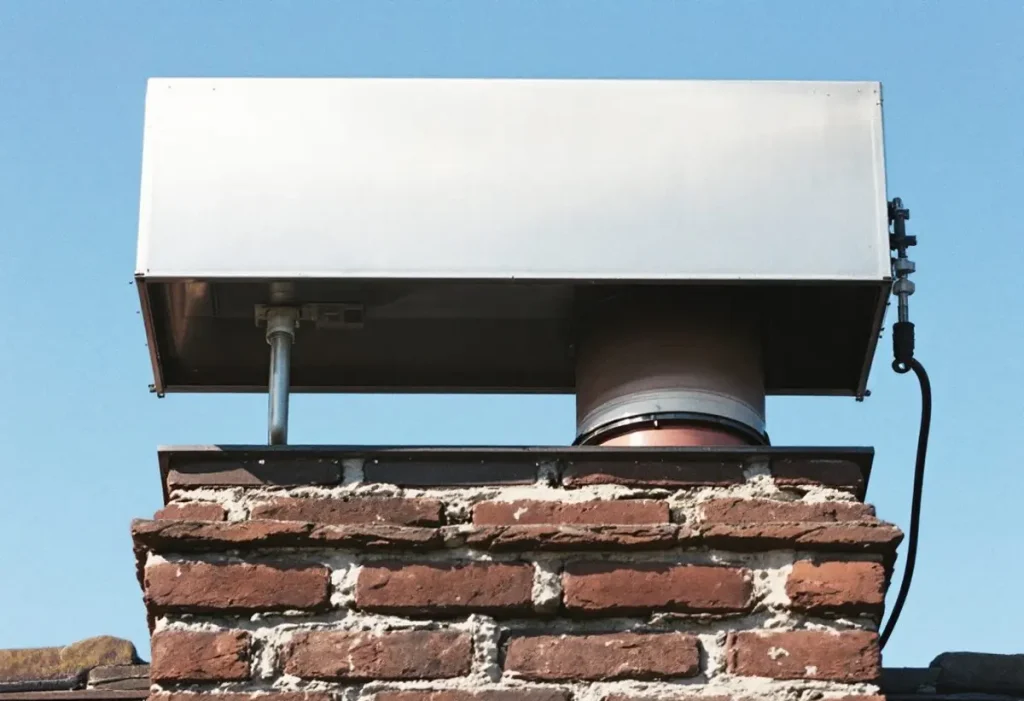
Throat damper vs top-sealing damper: which fireplace damper seals better?
A top-sealing damper is designed to seal better. U.S. Fireplace Products says its Top Damper “seals with a flat rubber gasket when closed,” while DOE warns that metal flue parts can “warp or break, creating a channel for air loss” (DOE air sealing, archived copy). No federal test rates either type.
| Damper or seal | Where it sits | How it closes | What the source says |
|---|---|---|---|
| Throat damper | Throat, at least 8 inches above the opening | Handle or knob | IRC R1001.7.1: ferrous metal, operable from the room |
| Top-sealing damper | Chimney crown | Control in the firebox | Maker claim: flat rubber gasket; no federal leakage test |
| Automatic top damper (gas logs) | On top of the chimney | Motor opens it, then gas flows | ICC-ES ESR-3661: 6 to 24 inch diameters; manual damper blade removed |
| Chimney balloon or flue plug | Below the flue | Inflated or pushed in | DOE: reusable hundreds of times; deflates within seconds of heat |
| Tight-fitting glass doors | Fireplace face | Closed doors | R402.4.2: alternative to a tight damper; UL 127 or UL 907 |
Compiled by The HVAC Brief from the sources named in each row. The automatic option is covered by ICC-ES evaluation report ESR-3661: the Field Controls Flue Sentinel damper rotates open, proves the open position, and only then lets the gas valve open; after shutdown it closes “after a 30 to 40 second delay.” It is limited to decorative gas appliances for solid fuel fireplaces and requires any manual damper blade to be removed.
How do you tell if a fireplace damper is open?
Look before every fire rather than trusting the handle. Shine a flashlight up through the throat: seeing the flue means open; a flat metal plate overhead means closed. With no fire, a cold downdraft on your hand at the throat means it is open. A top-sealing damper has no plate in the throat, so look up the flue for daylight. If you find a plate that will not move, stop: in 2010 the CPSC recalled about 500 Simpson Dura-Vent anchor plates with dampers, sold January 2007 through May 2008, because some stuck or were “assembled backwards and are set to the closed position,” a carbon monoxide risk. Our carbon monoxide death data shows the stakes.
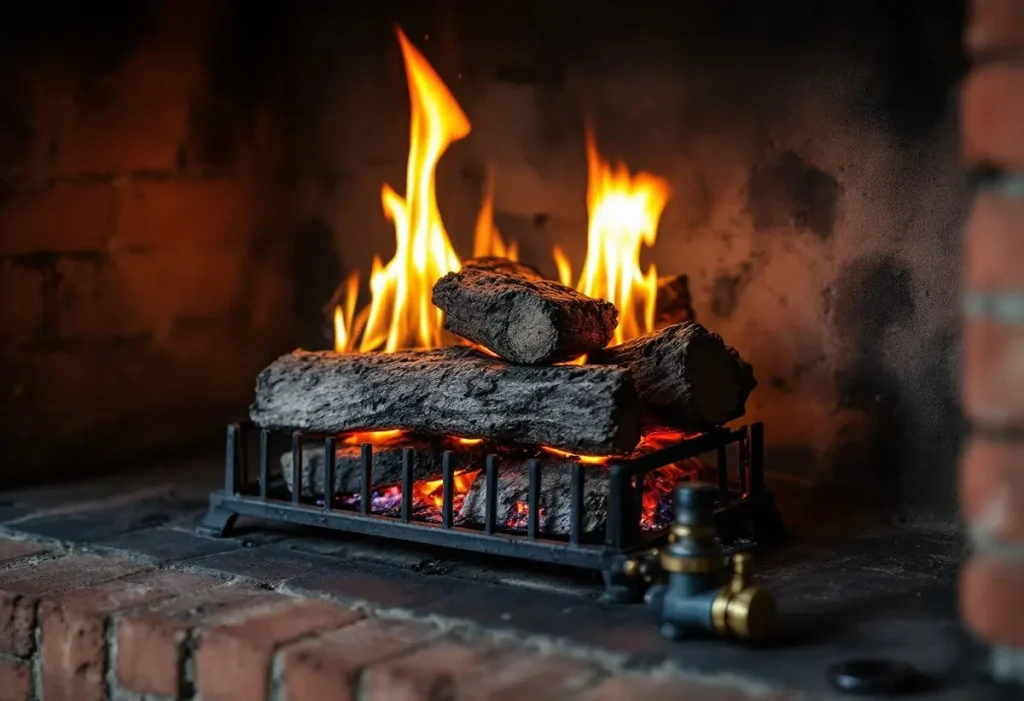
Do gas logs need the fireplace damper open?
Yes. Vented gas logs burn with the damper open, and their instructions require a clamp or stop so it never fully closes. The code points to those instructions: Section G2432.1 of Seattle’s 2021 amended reprint of the IRC, a section Washington did not amend, requires listing to ANSI Z21.60 and installation “in accordance with the manufacturer’s instructions” (chapter 24).
Hargrove’s manual says “a permanent free opening must be provided by either the fireplace chimney or chimney damper,” and that in Massachusetts the damper must be “permanently welded in the fully open position or completely removed” (Hargrove Olde World Basket guide). Its masonry table runs from 12.2 square inches (20,000 Btu per hour, 30 foot chimney) upward; for a 40,000 Btu per hour set the minimum is 33.8 at 6 feet and 21.6 at 30 feet. The Mason-Lite Virginiana manual says its damper clamp “must be permanently installed.”
If soot or fumes reach the room with the damper fully open, Hargrove says the draft is defective and the logs should not run. Venting details are in our gas fireplace venting guide.
Does building code require a fireplace damper?
For a new masonry fireplace, generally yes. Model IRC Section R1001.7.1 says masonry fireplaces “shall be equipped with a ferrous metal damper located not less than 8 inches (203 mm) above the top of the fireplace opening,” operable “from the room containing the fireplace.” That wording is unamended in Utah’s and New Jersey’s adoptions (IRC 2021 chapter 10, UpCodes).
Washington adds more, marked [W] in Seattle’s 2021 amended reprint of the IRC, chapter 10: “tightly fitting flue dampers,” an outside combustion air duct of “at least 6 square inches” with “an operable outside air duct damper,” and doors or a draft fan on site-built fireplaces. The 5% minimum opening for a closed masonry heater damper (R1002.2.1) is also a Washington amendment; the model IRC section has no such rule. Outside air is covered in our combustion air explainer.
The energy code adds one line nationally: new wood-burning fireplaces “shall have tight-fitting flue dampers or doors and outdoor combustion air” (R402.4.2, printed as N1102.4.2 in the IRC energy chapter, and the same in the 2018 Seattle Energy Code). Rules vary by jurisdiction and edition, so the local building department decides.
Should you fix a leaky fireplace damper or seal the flue?
If you never use the fireplace, seal the flue; if you use it, repair or replace the damper. DOE says “if you have a fireplace that you don’t use, plug and seal the flue,” and notes a forgotten chimney balloon “will automatically deflate within seconds of coming into contact with heat.” Never light a fire with any plug in place, and never use one in a flue that serves gas logs.
Have a sweep check the flue first; our chimney liner guide covers when the flue itself needs work. For real heat, DOE suggests an “EPA-certified insert, installed by a certified professional,” compared in our fireplace insert guide.
How we researched this
Researched October 31, 2026; updated November 27, 2026. The update rechecked every code citation. Seattle’s 2021 reprints mark Washington changes with [W], so each cited section was checked: R1001.7.1, R1002.2.1 and the local exhaust table M1505.4.4.1 are Washington amendments, while G2432.1 and M1503.6 are unamended. Model IRC wording for R1001.7.1, M1503.6, M1505.4.4 and N1102.4.2 was read in Utah’s and New Jersey’s adoptions on UpCodes, where no amendment is marked for those sections, because codes.iccsafe.org blocks automated reading. The heat example was corrected to Building America’s 250 CFM net exhaust. DOE’s Energy Saver pages are offline, so archived copies were used. Excluded: an unsourced “up to 30%” bill claim and damper price ranges that rank today, and Reddit, skipped because this is a carbon monoxide topic.
Frequently asked questions
Should the fireplace damper be open or closed in summer?
Closed, unless something is burning. DOE’s air sealing guidance is to keep the flue damper “tightly closed when not in use,” which applies year round because an open flue lets conditioned air escape. If the damper no longer seals and the fireplace is unused, DOE suggests a chimney balloon, which it says can be reused hundreds of times.
Can I close the damper if the fire is almost out?
No. New Jersey’s Division of Fire Safety says not to close the damper before the fire has died out and the embers are cold. DOE Building America warns that a low fire backdrafts easily: even a 50 CFM kitchen or bath exhaust fan can pull its combustion pollutants into the home.
What is a damper clamp on a gas fireplace?
A clamp or stop on the damper blade so it cannot fully close while vented gas logs are installed. The Mason-Lite Virginiana manual says its clamp “must be permanently installed.” Hargrove’s table sets the permanent opening at 12.2 to 33.8 square inches for masonry chimneys, depending on chimney height and burner input.
Do all fireplaces have a damper?
Not all. IRC Section R1001.7.1 requires a ferrous metal damper in masonry fireplaces, and factory-built units follow their listing. DOE Building America says direct-vent gas fireplaces take 100% of their combustion air from outdoors and use tight-fitting glass doors, so follow that unit’s manual rather than a masonry rule.
Can a bathroom fan backdraft a fireplace?
Yes, when the fire burns low. DOE Building America says a 50 CFM kitchen or bath exhaust fan could backdraft fireplace pollutants into the home. The model 2021 IRC sets bathroom fans at 50 cfm intermittent and kitchen fans at 100 cfm intermittent, so ordinary code-minimum fans are enough to do it.
How much heat goes up an open fireplace damper?
While burning, DOE says a traditional fireplace can draw as much as 300 cubic feet per minute of room air. Reheating that air at a 40 degree F difference takes about 12,960 Btu per hour, by our calculation with ACCA’s 1.08 constant. Idle leakage through a closed damper needs a blower door test to measure.
Sources
- U.S. Department of Energy, Energy Saver. “Wood and Pellet Heating.” Archived copy. https://web.archive.org/web/20260623235300id_/https://www.energy.gov/energysaver/wood-and-pellet-heating. Accessed November 2026.
- U.S. Department of Energy, Energy Saver. “Air Sealing Your Home.” Archived copy. https://web.archive.org/web/20260627190912id_/https://www.energy.gov/energysaver/air-sealing-your-home. Accessed November 2026.
- DOE Building America Solution Center. “Fireplaces and Wood Stoves Have Proper Ventilation.” https://basc.pnnl.gov/resource-guides/fireplaces-and-wood-stoves-have-proper-ventilation. Accessed November 2026.
- International Code Council, via UpCodes. “2021 International Residential Code, Chapter 15: Exhaust Systems (Utah adoption; M1503.6 and Table M1505.4.4 unamended).” https://up.codes/viewer/utah/irc-2021/chapter/15/exhaust-systems. Accessed November 2026.
- International Code Council, via UpCodes. “2021 International Residential Code, Chapter 10: Chimneys and Fireplaces (Utah adoption; R1001.7.1 unamended).” https://up.codes/viewer/utah/irc-2021/chapter/10/chimneys-and-fireplaces. Accessed November 2026.
- International Code Council, via UpCodes. “2021 International Residential Code, Chapter 11: Energy Efficiency (Utah adoption; N1102.4.2).” https://up.codes/viewer/utah/irc-2021/chapter/11/re-energy-efficiency. Accessed November 2026.
- City of Seattle. “2021 Seattle Residential Code, Chapter 15 (Seattle’s amended reprint of the IRC; Washington amendments marked [W]).” https://www.seattle.gov/documents/Departments/SDCI/Codes/SeattleResidentialCode/2021SRCChapter15.pdf. Accessed November 2026.
- City of Seattle. “2021 Seattle Residential Code, Chapter 10 (Seattle’s amended reprint of the IRC; R1001.7.1 and R1002.2.1 amended [W]).” https://www.seattle.gov/documents/Departments/SDCI/Codes/SeattleResidentialCode/2021SRCChapter10.pdf. Accessed November 2026.
- City of Seattle. “2021 Seattle Residential Code, Chapter 24: Fuel Gas (Seattle’s amended reprint of the IRC; G2432.1 unamended).” https://www.seattle.gov/documents/Departments/SDCI/Codes/SeattleResidentialCode/2021SRCChapter24.pdf. Accessed November 2026.
- City of Seattle. “2018 Seattle Energy Code, Residential Chapter 4 (R402.4.1.2, R402.4.2).” https://www.seattle.gov/documents/Departments/SDCI/Codes/SeattleEnergyCode/2018SECResidentialChapter4.pdf. Accessed November 2026.
- New Jersey Division of Fire Safety. “Fireplace and Chimney Safety” fact sheet. https://www.nj.gov/dca/divisions/dfs/publications/publication/fsf_updated/fs_facts_fireplace_chimney.pdf. Accessed November 2026.
- Fairfax County Fire and Rescue. “Fireplace and Ashes Safety Tips.” https://www.fairfaxcounty.gov/fire-ems/sites/fire-ems/files/Assets/Documents/PDF/fireplace_and_ashes_safety_tips.pdf. Accessed November 2026.
- U.S. Consumer Product Safety Commission. “Simpson Dura-Vent Recalls Fireplace Dampers Due to Carbon Monoxide Poisoning Hazard.” https://www.cpsc.gov/Recalls/2010/simpson-dura-vent-recalls-fireplace-dampers-due-to-carbon-monoxide-poisoning-hazard. Accessed November 2026.
- ICC Evaluation Service. “ESR-3661, Field Controls Automatic Fireplace Damper.” https://icc-es.org/wp-content/uploads/report-directory/ESR-3661-PMG.pdf. Accessed November 2026.
- Hargrove. “Olde World Basket Vented Decorative Appliance Installation and Operation Guide.” https://fireplacedoorsonline.com/images/companies/1/Manuals/Hargrove/OLDE%20WORLD%20BASKET%20VENTED%20_New_.PDF. Accessed November 2026.
- Masonry Fireplace Industries. “Mason-Lite Virginiana Standard Burner Manual.” https://cdn.shopify.com/s/files/1/0813/8725/8148/files/Mason-Lite_Virginiana_Standard_Burner_Manual.pdf. Accessed November 2026.
- U.S. Fireplace Products. “Top Damper” brochure (maker claims). https://zoro.com/static/cms/enhanced_pdf/Lindemann%20Chimney%20dba%20US%20Fireplace%20Products_ThexxTopxxDamperxxxxxxBrochurexx4c49de.pdf. Accessed November 2026.
- ACCA. “A Split in Diagnosis.” https://hvac-blog.acca.org/a-split-in-diagnosis/. Accessed November 2026.
Leave a Reply