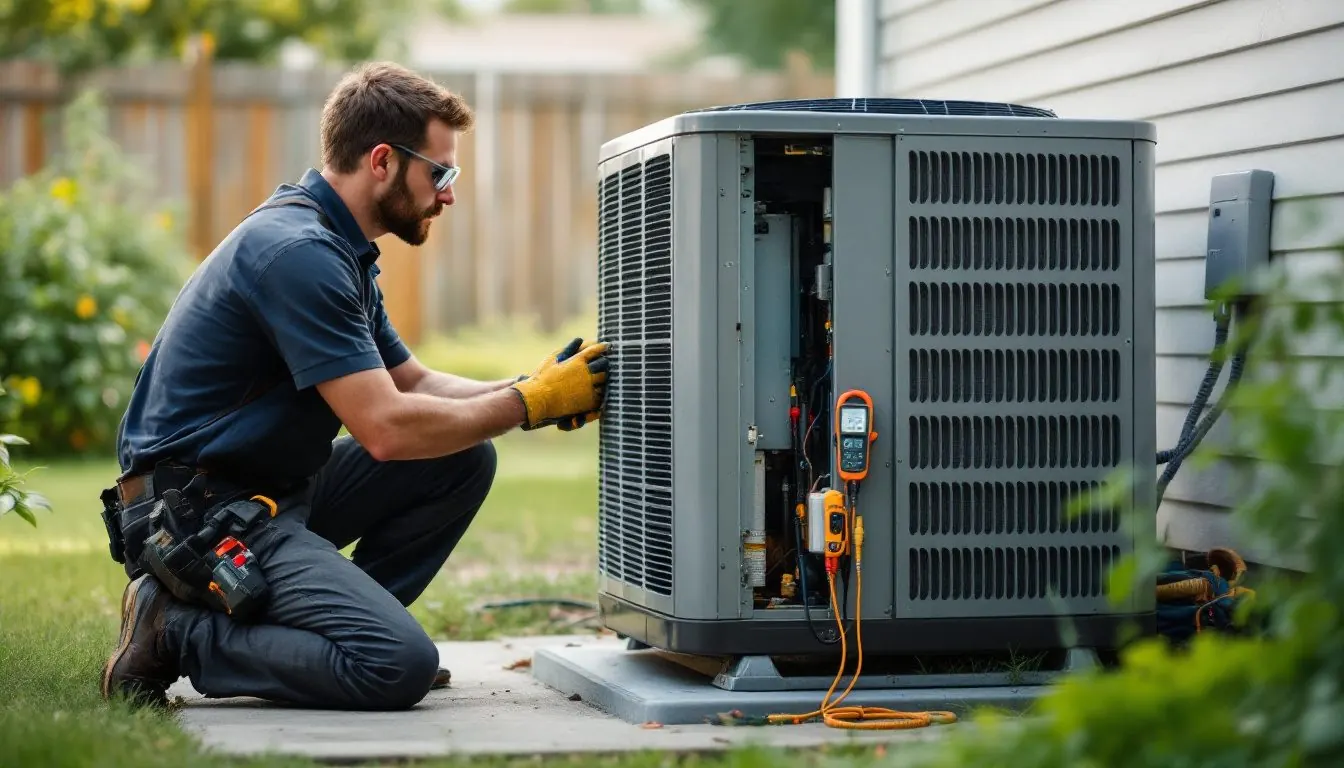
What is a hard start kit for AC? It is a start capacitor plus a relay (or a PTC thermistor) that gives a single phase compressor extra torque for a fraction of a second, then drops out. It helps a healthy compressor on weak voltage. It does not fix a failing one, and the wrong kit can harm a good one. Below: when a kit is worth it, how one is wired, and what makers say about the damage risk.
Key Takeaways
- Copeland says start assist devices are “usually not required” on its residential scrolls (Bulletin AE4-1331 R9, 2024).
- Copeland puts locked rotor current at “six or more times” running current, for 100 to 300 milliseconds (AE4-1331).
- Goodman’s 3 ton GLXS3B lists 13.4 RLA and 83.3 LRA; its 1.5 to 2.5 ton rotary models ship with a factory hard start kit (SS-GLXS3B-R32, 2024).
- Micro-Air claims its EasyStart Flex soft starter cuts start current “by up to 75%” (maker claim).
- A Goodman limited warranty excludes “Parts not supplied or designated by Goodman” (DSXC/DSZC certificate), so use the kit the maker lists.
- OSHA requires that “Capacitors shall be discharged” before electrical work (29 CFR 1910.333).
What does a hard start kit for an AC actually do?
It adds starting torque for the first moments of each start, then takes itself out of the circuit. A typical kit is a start capacitor wired alongside the run capacitor, plus a relay or thermistor that disconnects it once the motor turns.
The DOE Fundamentals Handbook describes single phase motors that use a starting winding for torque and disconnect it “when the motor reaches 70 to 80% of synchronous speed” (DOE-HDBK-1011/4-92). A hard start kit does that job with a relay outside the sealed compressor. The run capacitor stays in circuit throughout; our guide to run and dual run capacitors covers it.
What do RLA and LRA on the nameplate tell you about the starting surge?
RLA is rated running current; LRA, locked rotor amps, is what the compressor draws with the rotor stalled, as it is at every start. Thermostats add their own delay to protect the compressor, which is why a Sensi thermostat flashing its set temperature usually means the compressor is waiting out a short lockout before it starts. Copeland says LRA “is normally six or more times higher than the rated running amperage” and lasts “from 100 to 300 milliseconds until the rotor starts turning.”
The plate number is set by locking the compressor at the highest nameplate voltage and reading current “after four seconds,” Copeland says. Low voltage cuts starting torque, so the motor sits locked longer, and that stall dims the lights. A heat pump that growls and dims the lights at every cold start is among the fault sounds sorted in a heat pump making loud noise, apart from the brief defrost whoosh that is normal. A cold start after refrigerant has migrated into the oil is harder still, which is the job of the crankcase heater.
Real data plates, from Goodman’s 2024 GLXS3B specification sheet (ratio column is our arithmetic):
| Goodman model | Size and compressor | RLA | LRA | LRA ÷ RLA | Start help Goodman lists |
|---|---|---|---|---|---|
| GLXS3BN1810 | 1.5 ton, rotary | 8.2 | 41.2 | 5.0x | Factory installed hard start kit |
| GLXS3BN3010 | 2.5 ton, rotary | 11.2 | 52.5 | 4.7x | Factory installed hard start kit |
| GLXS3BN3610 | 3 ton, scroll | 13.4 | 83.3 | 6.2x | CSR-U-1 accessory kit |
| GLXS3BN4810 | 4 ton, scroll | 19.4 | 127.7 | 6.6x | CSR-U-2 or CSR-U-3 accessory kit |
| GLXS3BN6010 | 5 ton, scroll | 23.9 | 148.0 | 6.2x | CSR-U-2 or CSR-U-3 accessory kit |
The scrolls land at 6.2 to 6.6 times, in line with Copeland’s “six or more.” The rotaries run nearer 5 times. Our breakdown of air conditioner watts and amps covers running draw and circuit sizing.
PTC, potential relay or soft starter: which hard start kit is which?
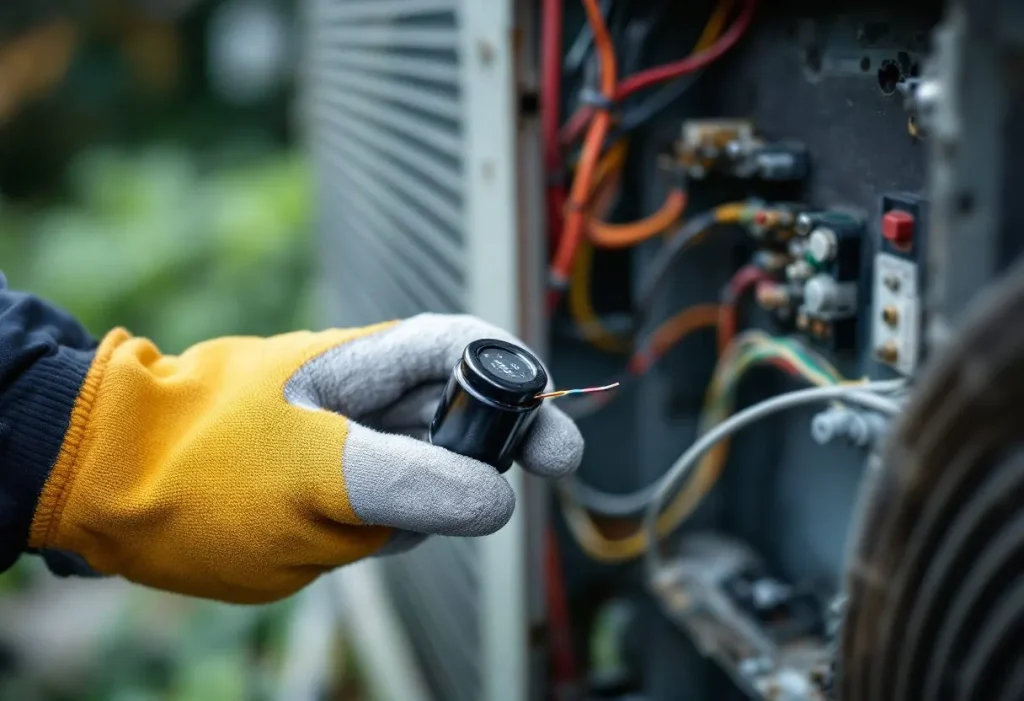
Three devices share the name. Two add torque; the soft starter limits the current peak instead.
| Device | How it drops out | What it changes at start | Where the maker or OEM points it |
|---|---|---|---|
| Start capacitor and potential relay (RectorSeal Kickstart KS-1, Goodman CSR-U kits) | Relay opens once the motor is up to speed | More torque, shorter locked rotor time | Low voltage, high head pressure, non-bleed TXV on rotary or reciprocating units |
| PTC start device | Resistance rises as it heats, choking off the start circuit | A smaller boost | Copeland: 10 to 25 ohm PTC “for less severe voltage drops” |
| Electronic soft starter (Micro-Air EasyStart Flex) | Electronic control of each start | Lower peak current, gentler ramp | Generators, inverters, limited utility power (Micro-Air) |
RectorSeal sells its KS-1, a two wire kit “with mechanical potential relay” for 3.5 to 5 ton units, on the claim that it drops out the start capacitor “at optimum time” to avoid “excessive heat build up” (maker claim). That names the real risk: a relay that sticks closed. A start relay stuck closed is also on the short list of causes behind replacement capacitors that keep failing.
In short, a hard start kit makes the compressor start faster; Copeland says start components “will substantially reduce start time.” A soft starter makes it start gentler, by “gradually increasing the voltage to the compressor motor,” in Micro-Air’s words.
When is a hard start kit for a compressor worth it?
When the equipment maker calls for one or the power supply is the problem. Manufacturer literature names four cases:
- Weak supply. Copeland warns of voltage “sag” on “a poor power supply,” with “light dimming or a buzzing noise where wire is pulled through conduit.”
- Non-bleed metering on rotary or reciprocating units. Goodman’s GLXS3B sheet says units with reciprocating or rotary compressors “require the use of start-assist components” with a non-bleed thermal expansion valve or liquid line solenoid. Our TXV explainer covers non-bleed designs.
- Power blips. Copeland says interruptions under half a second can spin single phase scrolls backward, and calls a start kit “another effective means of mitigating” it.
- Factory spec. Goodman fits one at the factory on its 1.5 to 2.5 ton GLXS3B rotary models.
For scrolls, Copeland is blunt: start assist is “usually not required, even if a system utilizes non-bleed expansion valves,” because the scrolls “always start unloaded.” Check voltage first. Copeland guarantees its 208/230 volt PFV scrolls start at 187 volts or higher and wants no less than 197 volts once running. Goodman’s plate gives the same floor: 197/253 volts.
When is a hard start kit a band-aid on a dying compressor?
It is a band-aid when the compressor itself is why the start fails. A kit adds torque; it does not repair a shorted winding or worn parts, and it can mask the warning. That warning is often an outside AC unit humming with nothing turning, which usually traces to a failed run capacitor, a stalled fan motor or a locked compressor. A scroll that suddenly needs help signals that something changed.
Diagnose in this order; every step past the first is licensed work:
- Note the symptom: a hum then a click off, lights dimming at start, or a breaker that trips on startup rather than after running.
- Measure voltage during the start attempt against the 187 and 197 volt floors.
- Test the run capacitor and the contactor that switches the outdoor unit, two smaller parts that can mimic a weak compressor.
- Check windings and insulation against the maker’s service data.
- Count starts: a unit that is short cycling takes a locked rotor hit on every extra start. Goodman lists an ASC01A anti-short cycle kit for every GLXS3B.
If supply and parts check out and a rotary or reciprocating unit still struggles, the kit its maker lists is a legitimate repair. If the windings fail, the question becomes replacing the compressor or the outdoor unit.
How is a hard start kit wired?
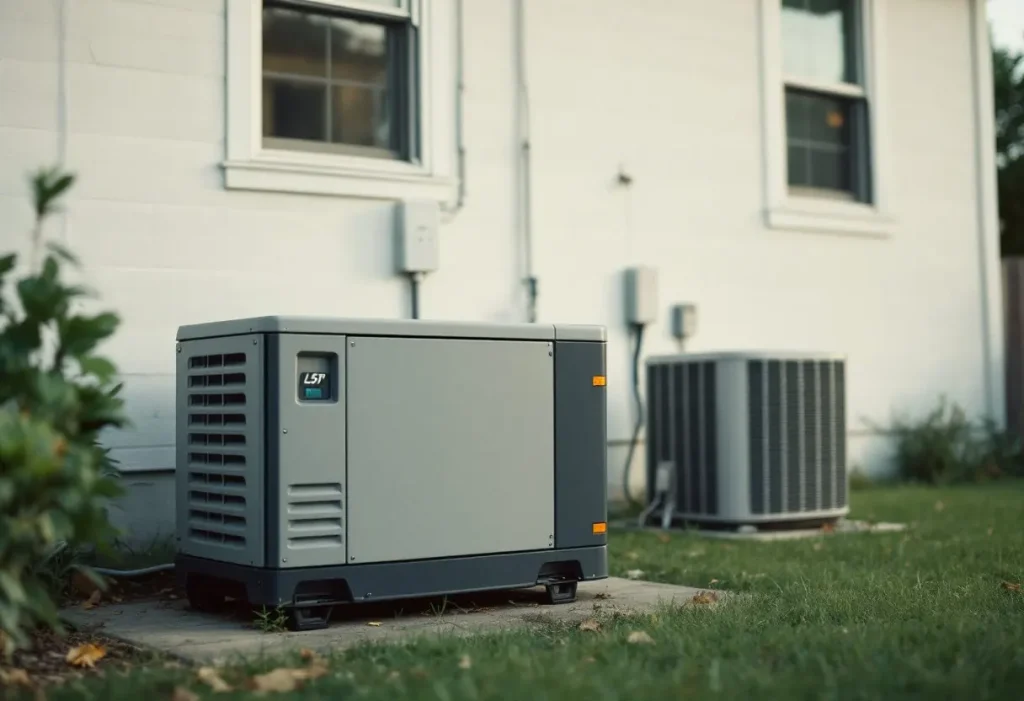
A potential relay kit connects at three points: the contactor’s two load terminals and the HERM terminal of the dual run capacitor, which feeds the compressor’s start winding. The clearest maker procedure we found is Johnson Controls’ manual for its S1-2SA067 hard start kits, written for its 13+ SEER air conditioners and heat pumps rated 208/230 volt single phase (Johnson Controls 5006452-UAI-H-0522).
The kit holds a potential (start) relay, a start capacitor with leads, screws and a capacitor strap. Johnson Controls says to open the main disconnect first because “one side of the contactor remains closed at all times.” The start capacitor mounts beside the dual run capacitor under one strap. If the unit already has a solid-state start device, that device and its red and brown connections to the dual capacitor come out first.
| Kit lead | From | To |
|---|---|---|
| Yellow (factory fitted) | Relay terminal 1 | Start capacitor |
| Black | Relay terminal 5 | Contactor T1 |
| Red | Start capacitor | Contactor T2 |
| Brown | Relay terminal 2 | Dual run capacitor HERM, the terminal wired to the compressor’s S (start) terminal |
Source: Johnson Controls 5006452-UAI-H-0522, installation steps 4 to 7. Terminal numbers belong to that kit’s relay; another maker’s relay can number them differently, so the diagram in the box and the one on the unit’s access panel govern.
Two-wire kits package the relay and capacitor so only two leads land in the unit. RectorSeal markets its Kickstart as an “easy install 2-wire design” that “correctly replaces over 60 different OEM combinations of start capacitors and potential relays” (RectorSeal Kickstart page, maker claim). The trade-off is in the next section: what takes the start capacitor out of the circuit, and how fast.
Johnson Controls lists three conditions that justify a field-installed kit: low supply voltage, exceptionally high operating temperatures and short thermostat cycling, used “when such conditions exist and cannot be corrected.” It also says “Incorrect installation may damage equipment, can create a shock hazard, and voids the warranty.” The same manual notes that some states require installers to be licensed.
Can a hard start kit damage a compressor?
Yes, if it is the wrong kit or the start capacitor stays in the circuit too long. Johnson Controls prints the warning in its kit manual: “Do not mismatch kits because this may cause damage to the compressor.” A correct kit, matched to the compressor and wired to the diagram, is a part the maker designs in; Goodman fits one at the factory on its 1.5 to 2.5 ton GLXS3B rotary models.
The risk sits in the start winding. As the DOE handbook passage above describes, the starting circuit is meant to drop out as the motor nears full speed, and in a hard start kit the relay or thermistor does that job. The whole question is how quickly it lets go.
How fast the device drops out is where makers compete. RectorSeal says its Kickstart’s potential relay takes the start capacitor out “at less than 100 ms,” at 75% of full speed. It says a 3-wire “universal” kit with no potential relay leaves the start capacitor in circuit for 600 ms, and that “the longer the Start Cap stays in circuit, the greater the heat damages the start windings” (RectorSeal, maker claims). Both numbers are RectorSeal’s own, not independent tests, and they come from a company selling the relay type it favors.
Three faults turn a kit from help into harm:
- Wrong match. RectorSeal says a potential relay’s pick-up voltage is “exactly matched to counter-EMF,” the voltage the spinning compressor generates, so a relay chosen for another compressor can drop out at the wrong moment. Goodman lists CSR-U kits by model and Copeland lists model specific start parts for this reason.
- Stuck relay. Contacts that stick closed leave the start capacitor in circuit long after the start, the condition RectorSeal’s timing claims are about.
- Doubled devices. Johnson Controls removes any factory solid-state start device before fitting its kit.
The reverse claim, that a kit makes a healthy compressor last longer, is unproven. RectorSeal advertises that its device will “extend the life of compressors.” No federal survey records the age at which HVAC equipment fails, as our page on how long an HVAC system lasts explains, so there is no federal data to test that claim against.
Can a soft starter let a generator run central air?
A soft starter can, where a hard start kit usually cannot. A generator stalls on peak current; a hard start kit shortens the stall but is not built to cap the peak. That is why soft starters are popular on an RV air conditioner, which often has to start on a portable generator.
DOE’s Building America Solution Center says a motor “often needs 100% to 300% more power” to start, and sizes a 1,500 to 3,000 watt generator for just a refrigerator plus a small AC under 1,000 watts (BASC).
Micro-Air says its EasyStart Flex handles home units up to 6 tons and “can reduce your start up current by up to 75%.” Applied to the 3 ton GLXS3B’s 83.3 amp LRA, that claim would mean a start near 21 amps. That is our arithmetic on a maker claim, not a test. These products target single phase fixed speed motors; a variable speed system is a different machine, so ask its maker first.
Does a hard start kit void the warranty, and who should fit one?
It can, if the maker did not designate the part. Add-ons outside the cabinet answer to the manual too: an AC cage around the condenser works only if it keeps the side and overhead clearances the installation instructions print. A 2009 to 2010 Goodman limited warranty for DSXC and DSZC models excludes “Parts not supplied or designated by Goodman” and “Use of components or accessories not compatible with this unit.” It also excludes “Failure to start due to interruption and/or inadequate electrical service.”
So fit the kit the maker names: Goodman lists CSR-U part numbers by model, and Copeland lists model specific start parts in its Online Product Information. Terms differ by brand and year; our guide to what HVAC warranties cover explains the common exclusions.
Safety: this is licensed work
A kit wires into the compressor circuit inside a cabinet fed at 208/230 volts. OSHA 1910.333(b)(2)(ii)(C) requires that stored energy be released: “Capacitors shall be discharged.” An owner can safely note symptoms, shut the system off at the thermostat and the outdoor disconnect, and call a technician. If the outdoor unit is silent, start with the checks for an AC that will not turn on.
How we researched this
Researched October 8, 2026. None of the top three ranking pages for “hard start kit for ac” cited a manufacturer for its numbers. Every figure here comes from the eight sources listed below, each opened for this article; maker pages are labeled as claims. The LRA ÷ RLA ratios and the 21 amp soft start figure are our arithmetic.
Excluded: kit and labor prices (no federal price series), a trade blog’s untraced “seven times” figure, retailer listings, and Reddit (electrical safety topic).
Frequently asked questions
Do I need a hard start kit for my AC?
Usually not, if it is a scroll compressor on good voltage; Copeland says start assist is “usually not required” on its scrolls. You may need one on a weak supply, on a rotary or reciprocating unit with a non-bleed TXV, or where the maker specifies one, as Goodman does on its 1.5 to 2.5 ton GLXS3B models.
Does a hard start kit save electricity?
We found no manufacturer or federal source showing running savings. Copeland describes start components only in terms of start time, light dimming and conduit buzzing, all effects of the 100 to 300 millisecond inrush, not of running draw. Treat any savings claim as unproven.
Will a hard start kit fix a compressor that hums but will not start?
Sometimes, if the cause is low voltage or high head pressure, the conditions RectorSeal names for its Kickstart. It will not fix a failed winding or run capacitor. A technician should check voltage against Copeland’s 187 volt starting floor and test the capacitor and windings first.
What is the difference between a hard start kit and a soft start?
A hard start kit adds torque so the compressor starts faster. A soft starter limits peak current so the start is gentler. Micro-Air claims its EasyStart Flex cuts start current by up to 75 percent, which is why soft starters suit generators and inverters.
Can I install a hard start kit myself?
Treat it as licensed work. The kit connects to the compressor circuit at 208/230 volts beside capacitors that hold charge, and OSHA 1910.333 requires that “Capacitors shall be discharged” before work. An owner can note symptoms and shut the unit off.
What size hard start kit do I need?
The one your equipment maker lists. Goodman names the CSR-U-1 for its 3 ton GLXS3B and the CSR-U-2 or CSR-U-3 for 4 and 5 tons; Copeland lists model specific parts online. Universal kits are sized by tonnage: RectorSeal’s KS-1 covers 3.5 to 5 tons.
Which wire on a hard start kit goes to the HERM terminal?
In Johnson Controls' S1-2SA067 kit, the brown lead from relay terminal 2 goes to the HERM terminal of the dual run capacitor, the terminal already wired to the compressor's start terminal. The black lead from relay terminal 5 goes to contactor T1 and the red lead from the start capacitor goes to contactor T2. Other kits number their relays differently, so follow the diagram that ships with the kit.
Sources
- Copeland. “Application Engineering Bulletin AE4-1331 R9: ZP16 to ZP61K5E R-410A 1.5 to 5 Ton Copeland Scroll Compressors.” https://apps.copeland.com/Publications/AEB/AE4_1331_R9.pdf. Accessed October 2026.
- Goodman Manufacturing. “GLXS3B R-32 Split System Air Conditioner, Specification Sheet SS-GLXS3B-R32” (hosted copy). https://cdn.shopify.com/s/files/1/0748/4745/3475/files/Goodman-GLXS3B-specsheet_fc59d0b3-c33b-4712-828e-42b0b39d4e89.pdf. Accessed October 2026.
- Goodman Manufacturing. “Limited Warranty, Models DSXC, DSZC” (distributor hosted copy). https://resource.ecmdi.com/is/content/Watscocom/Gemaire/goodman_dsxc160241_article_1371468297440_en_war.pdf. Accessed October 2026.
- OSHA. “29 CFR 1910.333, Selection and use of work practices.” https://www.osha.gov/laws-regs/regulations/standardnumber/1910/1910.333. Accessed October 2026.
- U.S. Department of Energy. “DOE Fundamentals Handbook: Electrical Science, Volume 4 (DOE-HDBK-1011/4-92).” https://www.energy.gov/sites/default/files/2026-04/DOE-HDBK-1011-92_VOL4.pdf. Accessed October 2026.
- DOE Building America Solution Center (PNNL). “Emergency Air Conditioning and Food Refrigeration.” https://basc.pnnl.gov/resource-guides/emergency-air-conditioning-and-food-refrigeration. Accessed October 2026.
- Micro-Air. “EasyStart Flex Home AC Soft Starter” (maker claims). https://www.micro-air.com/products_easystart_368_softstarter_microair.cfm. Accessed October 2026.
- RectorSeal. “Kickstart Hard Start Device KS-1” (maker claims). https://rectorseal.com/kickstart-ks-1-for-3-5-5-0-ton/. Accessed October 2026.
- Johnson Controls Ducted Systems. “Accessory Kit Installation Manual: Hard Start Kits (S1-2SA067*), 5006452-UAI-H-0522.” https://files.hvacnavigator.com/p/5006452-uai-h-0522.pdf. Accessed November 2026.
- RectorSeal. “Kickstart Potential Relay and Start Capacitor” (maker claims). https://rectorseal.com/kickstart-lp. Accessed November 2026.
Leave a Reply