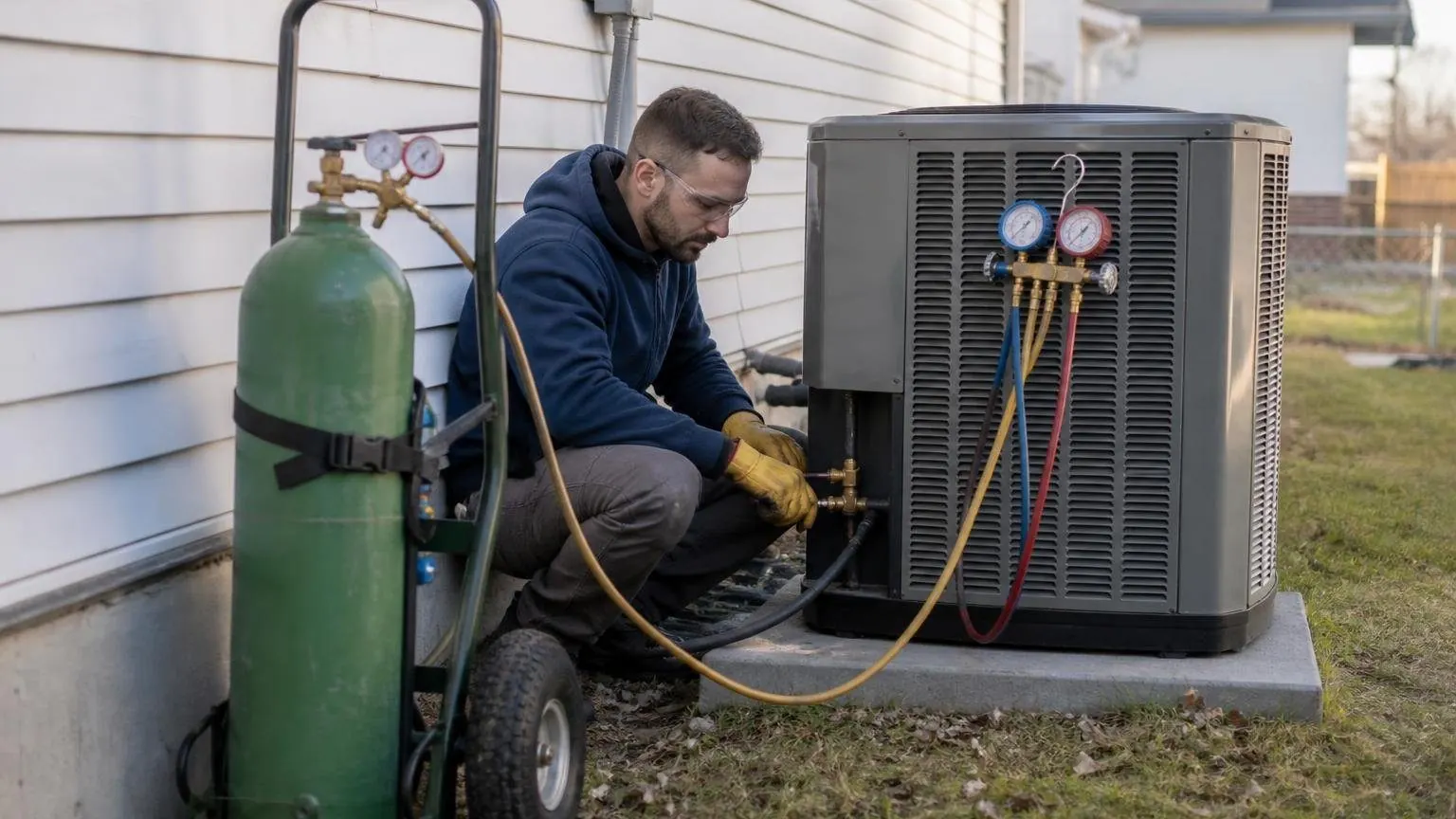
A nitrogen pressure test fills a brazed refrigerant circuit with dry nitrogen to the pressure in the equipment manual, then watches the gauge for a drop. Goodman specifies 450 PSIG for 15 minutes on R-410A; Carrier’s R-454B units use about 200 psi for 1 hour. Correct the reading for temperature before calling it a leak. Chillers test far lower: Carrier caps its 19DV centrifugal at 45 psig and Trane’s CenTraVac at 8 psig.
Key Takeaways
- Goodman’s GSX manual calls for 450 PSIG of dry nitrogen held at least 15 minutes, with a regulator and a relief valve set no higher than 450 psig (Goodman IO-258W).
- Mitsubishi’s MXZ-SM manual pressurizes in steps of 73, 218 and 601 PSIG and passes the pipe if it holds for about one day (Mitsubishi Electric).
- R-454B manuals we read test lower than R-410A ones: 160 psig (Lennox SL25KCV), about 200 psi for 1 hour (Carrier 26VNA1) and 250 psig (York YC3 series); Rheem uses nameplate design pressure for 60 minutes.
- Never oxygen or air: Bryant warns oxygen mixtures “can lead to an explosion” (Bryant).
- Venting test nitrogen is legal: 40 CFR 82.154 exempts “Nitrogen in any application” from the venting ban (eCFR).
- By our gas law arithmetic (NIST SP 811 constants), a 20°F overnight cooldown takes a tight 450 psig test to about 433 psig.
What is a nitrogen pressure test, and why dry nitrogen?
A nitrogen pressure test, also called a standing pressure test, proves a new or repaired refrigerant circuit is tight before it is evacuated and charged. Charging then follows the maker’s target for superheat and subcooling, with piston systems set by superheat and TXV systems by subcooling. Dry nitrogen is used because it is inert, carries no moisture and is exempt from the federal venting ban, so it can be released when the test ends.
It sits between brazing and evacuation: a new line set run between the coil and condenser gets brazed, pressurized with nitrogen, held, then released and pumped down with an HVAC vacuum pump and micron gauge. Daikin’s DAQ instructions also allow dry helium and add: “No refrigerant shall be used for pressure testing to detect leaks.”
The test shows whether the circuit holds; finding the leak takes bubbles or a detector, covered in our guide to refrigerant leak detection methods. Testing matters most before a line set disappears into a stud bay, since refrigerant lines run in walls must have no field joint left behind the drywall.
What do you need before a nitrogen pressure test?
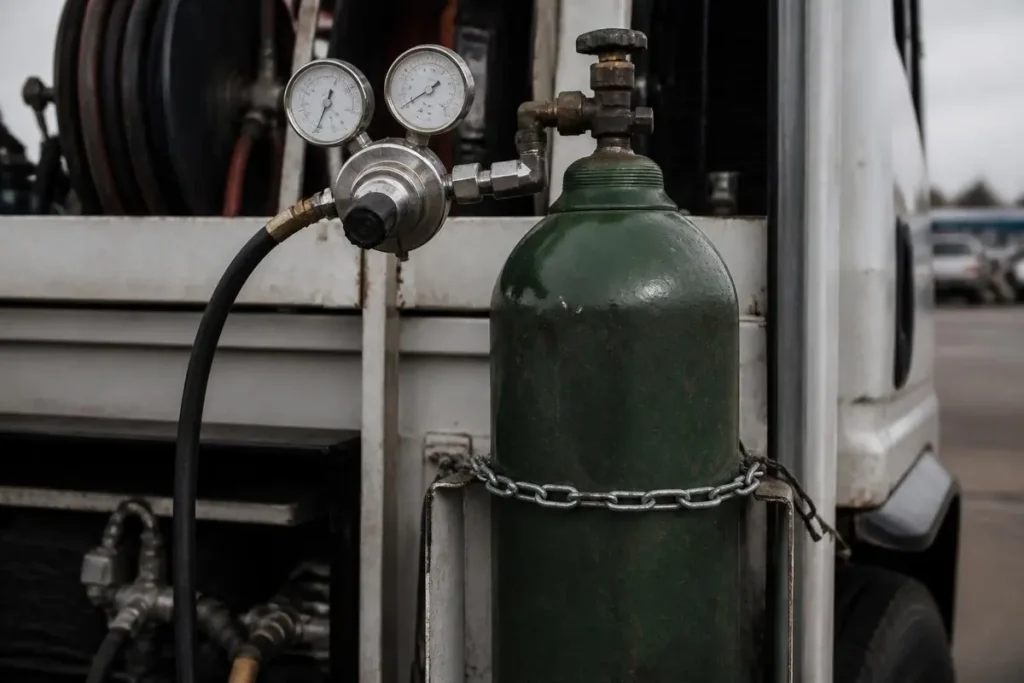
You need dry nitrogen, a regulator with a relief valve, hoses and gauges rated above the test pressure, a thermometer and bubble solution. Goodman’s manual makes the regulator and relief valve mandatory, with the relief “set to open at no more than 450 psig.”
Gauge. An analog or digital manifold gauge set, or a single test gauge. Bryant specifies hoses with a 700 psig service rating for Puron work; Rheem specifies 800 psig hoses for R-454B.
Core tool. Rheem removes the Schrader cores before brazing “to protect seals from heat damage.” Our Schrader valve explainer covers cores and caps.
Thermometer. Mitsubishi tells installers to “measure the surrounding temperature” at full pressure, because the reading moves with it.
Safety: no oxygen, no shop air
Goodman: “never use oxygen, high pressure air or flammable gases for leak testing.” Rheem warns that oxygen “reacts violently with oil.” OSHA’s welding rule, 29 CFR 1910.253, says a jet of oxygen “must never be permitted to strike an oily surface,” and every compressor circuit holds oil.
What nitrogen pressure test psi do equipment makers specify?
The manual for the unit on the job sets the number, and the documents we read range from 300 to 601 PSIG. There is no single “R-410A test pressure.”
| Document | Equipment | Test pressure | Hold | Pass rule |
|---|---|---|---|---|
| Goodman IO-258W (July 2021) | GSX condensing unit, R-410A | 450 PSIG | 15 minutes minimum | Does not drop below 450 PSIG |
| Daikin IOD-1063A (August 2024) | DAQ air handler, R-32 | 450 PSIG, nitrogen or helium | 15 minutes minimum | Does not drop below 450 PSIG |
| Mitsubishi MXZ-SM manual (2021) | Multi-zone outdoor unit, R-410A | 73, then 218, then 601 PSIG | 5 minutes per step, then about one day | Pressure does not decrease, after temperature correction |
| Rheem RP14AY/RP15AY | Heat pump, R-454B | Nameplate design pressure | 60 minutes | No drop; soap the braze joints if it falls |
| EPA GreenChill guideline | Commercial refrigeration | 300 psig minimum | 24 hours | No more than 1 pound change, same gauge |
One caution: Rheem’s R-454B manifold spec reads the low side only to 250 psig with a 550 psig retard, so read a 450 or 601 PSIG test on a gauge rated for it.
How much nitrogen pressure for R-410A and R-454B systems?
Use the number in the manual for the outdoor unit on the job. In the documents we read, R-410A equipment is tested at 450 to 601 PSIG, while the newer R-454B (A2L) equipment is tested at 160 to 250 psig, and Carrier caps its test at the Low Side Test Pressure printed on the outdoor unit’s rating plate.
| Refrigerant | Maker document | Nitrogen test pressure | Hold and pass rule |
|---|---|---|---|
| R-410A | Goodman GSX, IO-258W (July 2021) | 450 PSIG, relief valve set no higher than 450 psig | 15 minutes minimum; no drop below 450 PSIG |
| R-410A | Mitsubishi MXZ-SM (2021) | 73, then 218, then 601 PSIG | About one day; no decrease after temperature correction |
| R-454B | Carrier 26VNA1 (edition 08/24) | About 200 psi, not to exceed the rating plate Low Side Test Pressure | 1 hour; must not decrease, on a gauge with resolution no coarser than 5% of the charge |
| R-454B | Payne PH5SAN5, Carrier family (12/23) | About 200 psi | 1 hour; must not decrease |
| R-454B | York YC3, XC3, YC4 series (Aug 2024) | 250 psig | Bubble test every joint and flare cap, then release |
| R-454B | Lennox SL25KCV, 508447-01 (6/2025) | 160 psig over a trace of R-454B | Electronic detector check to 5 grams per year |
| R-454B | Rheem RP14AY/RP15AY | Nameplate design pressure | 60 minutes; soap the braze joints if it falls |
Compiled by The HVAC Brief from the installation manuals named, read November 2026. R-32 is a separate case: Daikin’s DAQ air handler uses 450 PSIG, as in the first table.
The lower R-454B numbers are a property of those manuals, not of the refrigerant. A 450 PSIG habit carried over from R-410A work can exceed a rating plate test pressure on an A2L unit, so read the plate before you open the regulator. The R-454B manuals also split on tracer gas: Lennox first adds a trace of R-454B, at most 2 ounces (57 g) or 3 psi, before the nitrogen, while York says not to use the system refrigerant to purge or leak test.
How do you pressure test AC lines with nitrogen, step by step?
Pressurize the line set and indoor coil through the service ports with the outdoor unit’s valves shut, raise pressure in stages, then isolate the cylinder and hold. Rheem says to “be certain both refrigerant shutoff valves at the outdoor unit are closed.”
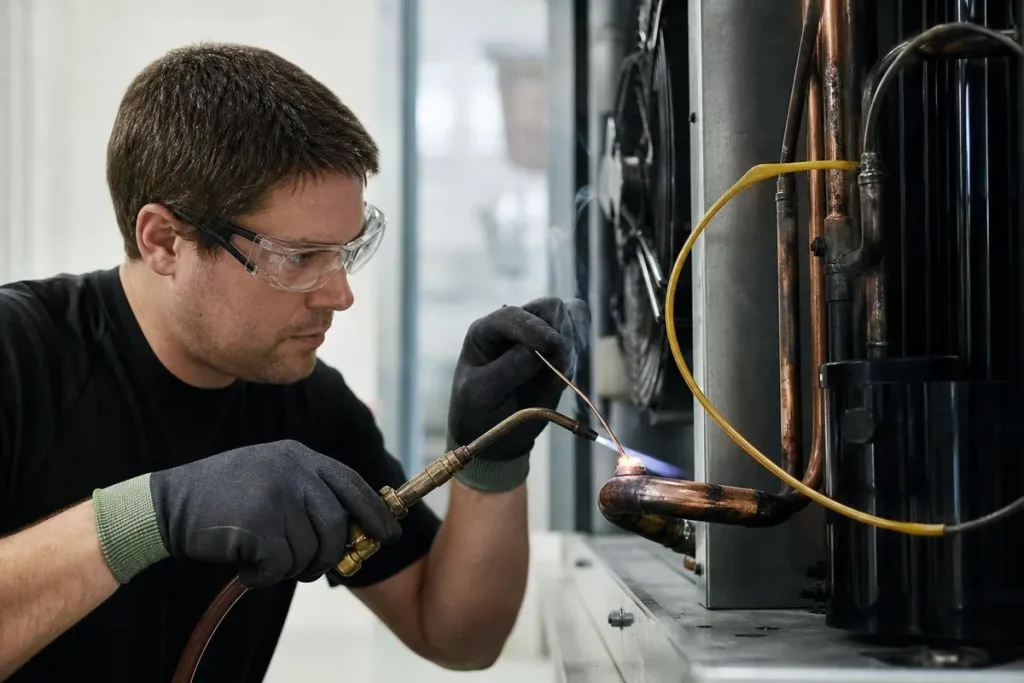
- Finish brazing with nitrogen flowing, let joints cool, and reinstall the Schrader cores.
- Connect the regulator, relief valve and hose; Mitsubishi uses both the liquid and gas service ports.
- Raise pressure in steps. Mitsubishi’s sequence is 73 PSIG and 218 PSIG with a five minute wait at each, then full pressure.
- Bubble every braze joint and flare nut at each step, while the pressure is still low.
- At full pressure, close the cylinder valve, as Rheem specifies, and record pressure, time and pipe temperature.
- Hold for the manual’s time and compare temperature corrected readings.
- Pass: release the nitrogen and evacuate. Fail: find the leak, repair, repeat.
That staged sequence comes from a multi-zone mini split manual, which also says to “use a leak detector or soapy water to check for gas leaks at the pipe connection sections.” On any mini split installation, that means every flare nut. Once the system runs, a head that blinks is more often signaling defrost or a power cut than a fault, as the guide to why a mini split is blinking explains.
Why flow nitrogen while brazing?
Flowing nitrogen during brazing keeps copper oxide scale from forming inside the joint. Goodman explains that the POE oil in R-410A systems “will clean any copper-oxide present from the inside of the refrigerant lines and spread it throughout the system,” which “may cause a blockage or failure of the metering device.”
A brazing purge is a flow, not a pressure test. Rheem says to flow dry nitrogen “while brazing, but do not allow pressure inside tubing which can result in leaks,” and to turn the regulator off once the system is full. Rheem states it flatly: “nitrogen must be flowed while brazing.”
A liquid line filter drier traps debris ahead of the metering device, a backstop rather than a substitute for the purge. Our refrigerant oil explainer covers why POE behaves differently from mineral oil.
How long should a nitrogen pressure test hold, and how do you correct for temperature?
Hold it for the manual’s time: 15 minutes for Goodman and Daikin, 60 minutes for Rheem, about one day for Mitsubishi and 24 hours in EPA’s GreenChill guideline for commercial refrigeration. On long holds, correct for temperature before calling it a leak.
Nitrogen in a sealed circuit follows the gas law: P1 / T1 = P2 / T2, with both values absolute. Add 14.7 to gauge psi (one standard atmosphere is 14.696 psi in NIST SP 811) and add 459.67 to °F to get degrees Rankine.
Worked example: a line set reaches 450 psig at 85°F in the afternoon and is read at 65°F the next morning.
- Absolute start pressure: 450 + 14.7 = 464.7 psia.
- Temperatures: 85 + 459.67 = 544.67°R and 65 + 459.67 = 524.67°R.
- Expected pressure: 464.7 × 524.67 ÷ 544.67 = 447.6 psia, which is 432.9 psig.
A reading near 433 psig passes, though it sits 17 psi below the start. The calculator below runs the same arithmetic for any start pressure.
Nitrogen pressure test temperature correction calculator
Enter the gauge pressure and pipe temperature when you closed the cylinder, then the temperature and gauge pressure at the end of the hold. The tool gives the pressure a tight system should read and a pass or fail.
Method: for a sealed, fixed volume of nitrogen, P2 = (P1 + 14.7) × (T2 + 459.67) ÷ (T1 + 459.67) − 14.7, with gauge psi made absolute by adding 14.7 (one standard atmosphere is 14.696 psi in NIST SP 811) and °F made absolute (degrees Rankine) by adding 459.67. Pass means the observed end pressure is no more than the allowed drop below that expected figure. Measure the pipe in the same spot both times and read both pressures on the same gauge, as EPA GreenChill directs. The manual for the unit sets the test pressure, the hold time and any allowed drop; this tool only removes the temperature effect.
| Start, psig at 80°F | Expected at 70°F | at 60°F | at 50°F | psi per 1°F |
|---|---|---|---|---|
| 160 (Lennox R-454B) | 156.8 | 153.5 | 150.3 | 0.32 |
| 200 (Carrier R-454B) | 196.0 | 192.0 | 188.1 | 0.40 |
| 250 (York R-454B) | 245.1 | 240.2 | 235.3 | 0.49 |
| 450 (Goodman R-410A) | 441.4 | 432.8 | 424.2 | 0.86 |
| 601 (Mitsubishi R-410A) | 589.6 | 578.2 | 566.8 | 1.14 |
HVAC Brief calculation with the formula above: expected gauge pressure of a tight, sealed nitrogen test that starts at 80°F, for the start pressures in the maker table. A lower test pressure moves less per degree, so a 200 psi R-454B test loses about 4 psi on a 10°F cooldown where a 450 PSIG test loses about 9.
Mitsubishi’s rule of thumb is about 1.5 PSIG per 1°C (1.8°F). Our arithmetic at 601 PSIG and 77°F gives about 1.15 psi per °F, or 2.1 psi per °C, so use the formula rather than the shortcut on a long hold.
GreenChill also says to read start and finish “using the same gauge.”
How are chillers pressure tested with nitrogen?
At far lower pressures than a split system. Low-pressure centrifugal chillers run on refrigerants such as R-1233zd(E), R-123 and R-514A, so their manuals cap a nitrogen test at tens of psig, not hundreds. Carrier’s 19DV manual warns: “Do not use air or oxygen as a means of pressurizing the chiller,” because R-1233zd(E) and air at elevated pressure “can undergo combustion.”
| Chiller document | Refrigerant | Ships with | Nitrogen leak test limit | Tightness rule |
|---|---|---|---|---|
| Carrier AquaEdge 19DV, 19DV-CLT-4SS (10-2020) | R-1233zd(E) | 15 psig dry nitrogen holding charge | Suggested 20 psig, maximum 45 psig, with a refrigerant tracer | Standing vacuum rise under 0.05 in. Hg in 24 hours; repair leaks above 0.1% of charge a year |
| Trane CenTraVac CVHE, CVHF, CVHG, CVHE-SVX02P-EN (October 2019) | R-123 or R-514A | Nitrogen holding charge of about 5 psig at 72°F | Dry nitrogen 8 psig maximum per machine; trace gas 1 lb maximum | Leak testing goes to a Trane service agency |
| Carrier 23XL screw chiller, 23XL-2SS (1994) | HCFC-22 or HFC-134a | 15 psig nitrogen holding charge | 230 psig maximum on the leak test; its nitrogen fill steps stop at 140 psig | Standing vacuum rise under 0.05 in. Hg in 24 hours |
Compiled by The HVAC Brief from the manufacturer documents linked, read November 2026.
The holding charge is the first test. Carrier says that if the 19DV’s factory 15 psig charge is still there, release it and pull a vacuum; if it is gone, add a small refrigerant tracer, pressurize with nitrogen to 20 psig and sweep every flange and joint with an electronic detector. The same manual says not to pressurize with nitrogen while the full refrigerant charge is in the vessel, “because purging the nitrogen is very difficult.”
Carrier’s final proof is a standing vacuum test: evacuate to at least 18 in. Hg vacuum, valve off the pump and read an absolute manometer or wet bulb indicator, since “dial gages cannot indicate the small amount of acceptable leakage.” How the evaporator, condenser and water loops fit around those vessels is laid out in our guide to how a chiller works and what it costs.
Federal leak rules now reach HFC chillers. From January 1, 2026, 40 CFR 84.106 covers appliances holding 15 pounds or more of a regulated HFC, or a substitute above 53 GWP, excluding residential and light commercial air conditioning. Chillers count as comfort cooling, with a 10% annual leak rate trigger. Each repair needs an initial verification test before refrigerant goes back in and a follow-up test within 10 days, with records kept three years. The rule names no method; a nitrogen test on the repaired, empty circuit fits the initial window.
Can you add refrigerant to the nitrogen to find a leak?
Some manuals allow a small trace charge, others forbid it, and federal guidance on venting the mixture is narrow. Goodman’s method charges “to 10 PSIG with the appropriate system refrigerant” and finishes to 450 PSIG with nitrogen so an electronic detector can sniff it. Daikin’s DAQ manual says no refrigerant shall be used.
The federal baseline is 40 CFR 82.154(a)(1): no one servicing an appliance may knowingly vent refrigerant, while “Nitrogen in any application” is exempt. EPA’s older Section 608 fact sheet said “mixtures of nitrogen and R-22 that are used as holding charges or as leak test gases may be released” (archived copy).
That page addressed ozone-depleting refrigerants such as R-22. Current 82.154 text has no trace gas clause, and we found no EPA statement extending the allowance to R-410A, R-454B or R-32. EPA’s GreenChill guideline “does not condone the use of fluorinated refrigerants” as tracers. The cautious course is to recover a traced charge with the equipment described in our refrigerant recovery guide; 82.154(c) already limits refrigerant sales to buyers with EPA 608 certification or their employers.
How we researched this
Updated November 12, 2026: we added four R-454B installation manuals (Carrier 26VNA1, Payne PH5SAN5, York YC3 series, Lennox SL25KCV) and the temperature correction calculator, which we checked against a published worked example and our own arithmetic. First researched October 18, 2026. We read 15 primary documents and cite 10: manuals from Goodman, Daikin, Mitsubishi Electric, Rheem and Bryant, 40 CFR 82.154 and 29 CFR 1910.253 via the eCFR API, two EPA documents and NIST SP 811. The temperature correction is our own arithmetic. Maker figures apply to named models.
Excluded: blog and tool-seller test pressures that traced to no manual, and prices, which no federal series covers. Reddit was not used because this is a safety topic.
Frequently asked questions
What psi should a nitrogen pressure test be for R-410A?
Use the figure in the installation manual for the unit. Goodman’s GSX manual specifies 450 PSIG with a relief valve set no higher than 450 psig, while Mitsubishi’s MXZ-SM manual steps up to 601 PSIG. Test pressure is not the operating pressure shown on a refrigerant pressure chart.
Why did my nitrogen pressure test drop overnight?
Usually temperature, not a leak. By our gas law arithmetic, a sealed 450 psig test that cools from 85°F to 65°F should read about 433 psig. Mitsubishi tells installers that a 1°C change moves pressure about 1.5 PSIG and to “make the necessary corrections.” A drop beyond the corrected figure means a leak.
Can you pressure test an AC with compressed air instead of nitrogen?
No. Bryant’s installation instructions say “never use air or gases containing oxygen for leak testing,” because pressurized mixtures containing oxygen “can lead to an explosion.” Goodman’s manual likewise bans oxygen, high pressure air and flammable gases for leak testing, and requires a pressure regulator and relief valve on the nitrogen line.
Is it legal to vent the nitrogen after the test?
Yes, for straight nitrogen. 40 CFR 82.154(a)(1) exempts “Nitrogen in any application” from the federal venting ban, and EPA’s GreenChill guideline says to release the nitrogen charge to the atmosphere with adequate ventilation. A charge traced with refrigerant is a different question, covered above.
Does a vacuum test replace a nitrogen pressure test?
No. A vacuum can only load joints by one atmosphere, about 14.7 psi, while Goodman’s test pushes 450 PSIG against them. Goodman and Daikin both run the standing pressure test first, then the deep vacuum. The vacuum decay test checks moisture and tightness at low pressure.
How much does an AC nitrogen pressure test cost?
We found no federal or national lab price series for it, so we do not publish a figure. Goodman, Rheem and Mitsubishi all list the test as an installation step. Hold time drives labor, from 15 minutes in Goodman’s manual to about a day in Mitsubishi’s.
What pressure do you nitrogen test a chiller to?
The chiller manual's figure, which sits far below split-system numbers. Carrier suggests 20 psig and allows 45 psig on its 19DV centrifugal, Trane limits dry nitrogen to 8 psig per machine on CenTraVac CVHE, CVHF and CVHG chillers, and Carrier's 23XL screw chiller manual caps a nitrogen leak test at 230 psig. Carrier then proves tightness with a standing vacuum test: less than 0.05 in. Hg rise in 24 hours.
Sources
- Goodman Manufacturing. “Condensing Unit Air Conditioning Installation & Service Reference, IO-258W.” July 2021. https://www.budgetheating.com/content/files/downloadables/gsx%20-%20installation%20manual.pdf. Accessed October 2026.
- Daikin Comfort Technologies. “DAQ Series Installation Instructions, IOD-1063A.” August 2024. https://daikincomfort.com/docs/default-source/daq-series-r-32/im-iod-1063a.pdf. Accessed October 2026.
- Mitsubishi Electric. “MXZ-SM36/48/60NAM, MXZ-SM36/42/48NAMHZ Installation Manual.” 2021. https://s1.img-b.com/build.com/mediabase/specifications/mitsubishi/1972912/mitsubishi-mxz-sm36namhz-2-msz-fs12na-msz-fs15na-installation-sheet.pdf. Accessed October 2026.
- Rheem Manufacturing. “RP14AY, WP14AY, RP15AY R-454B Heat Pump Installation Instructions.” 2023. https://www.budgetheating.com/content/files/downloadables/rp14ay%20wp14ay%20rp15ay%20installation%20instructions.pdf. Accessed October 2026.
- Bryant. “113A/114C Split System Air Conditioner Installation Instructions.” https://resource.carrierenterprise.com/is/content/Watscocom/bryant_114cnc018000_article_1457429453457_en_ii1. Accessed October 2026.
- eCFR. “40 CFR 82.154, Prohibitions.” https://www.ecfr.gov/current/title-40/chapter-I/subchapter-C/part-82/subpart-F/section-82.154. Accessed October 2026.
- U.S. EPA. “Complying With The Section 608 Refrigerant Recycling Rule” (archived copy). https://web.archive.org/web/20101221074352/http://www.epa.gov/ozone/title6/608/608fact.html. Accessed October 2026.
- U.S. EPA. “GreenChill Best Practices Guideline: Ensuring Leak-Tight Installations of Commercial Refrigeration Equipment.” https://www.epa.gov/sites/default/files/documents/LeakGuidelines.pdf. Accessed October 2026.
- eCFR. “29 CFR 1910.253, Oxygen-fuel gas welding and cutting.” https://www.ecfr.gov/current/title-29/subtitle-B/chapter-XVII/part-1910/subpart-Q/section-1910.253. Accessed October 2026.
- NIST. “Special Publication 811, Guide for the Use of the International System of Units.” 2008. https://nvlpubs.nist.gov/nistpubs/Legacy/SP/nistspecialpublication811e2008.pdf. Accessed October 2026.
- Carrier. “26VNA1 Infinity Variable Speed Air Conditioner with Puron Advance (R-454B) Refrigerant, Installation Instructions,” catalog 26VNA1-1SI, edition 08/24. https://esmithair.com/wp-content/uploads/2025/01/26VNA1.pdf. Accessed November 2026.
- Payne (Carrier). “PH5SAN5 Single-Stage Heat Pump with R-454B Refrigerant, Installation Instructions,” catalog PH5SAN5-01SI, edition 12/23. https://www.shareddocs.com/hvac/docs/1009/Public/0A/PH5SAN5-01SI.pdf. Accessed November 2026.
- Johnson Controls (York). “Installation Manual: R-454B Outdoor Split-System Air Conditioner, YC4, XC4, RC4, YC3, XC3, RC3, YC6, XC6 and RC6 Series.” 2024-08-15. https://www.yorknow.com/pub/media/documentation/yc3_installguide.pdf. Accessed November 2026.
- Lennox Industries. “SL25KCV Air Conditioner Installation Instructions, 508447-01.” June 2025. https://www.lennox.com/dA/57c99e20fc/508447-01b.pdf. Accessed November 2026.
- Carrier. “AquaEdge 19DV Two-Stage Back-to-Back Centrifugal Liquid Chillers with PIC6 Controls and HFO R-1233zd(E), Start-Up, Operation, and Maintenance Instructions,” form 19DV-CLT-4SS, 10-2020. https://www.shareddocs.com/hvac/docs/1005/Public/09/19DV-CLT-4SS.pdf. Accessed November 2026.
- Trane. “Installation, Operation, and Maintenance: CVHE, CVHF, and CVHG Water-Cooled CenTraVac Chillers, CVHE-SVX02P-EN.” October 2019. https://www.trane.com/content/dam/Trane/Commercial/global/products-systems/equipment/chillers/water-cooled/centrifugal-liquid/earthwise-ctv-simplex/CVHE-SVX02P-EN_10172019.pdf. Accessed November 2026.
- Carrier. “23XL Hermetic Screw Liquid Chillers with HCFC-22 and HFC-134a, Start-Up, Operation, and Maintenance Instructions,” form 23XL-2SS, 12-94. https://surplusgroup.com/wp-content/themes/SurplusGroup/media/7742/23xl-2ss_startup.pdf. Accessed November 2026.
- eCFR. “40 CFR 84.106, Leak repair.” https://www.ecfr.gov/current/title-40/chapter-I/subchapter-C/part-84/subpart-C/section-84.106. Accessed November 2026.
Leave a Reply